
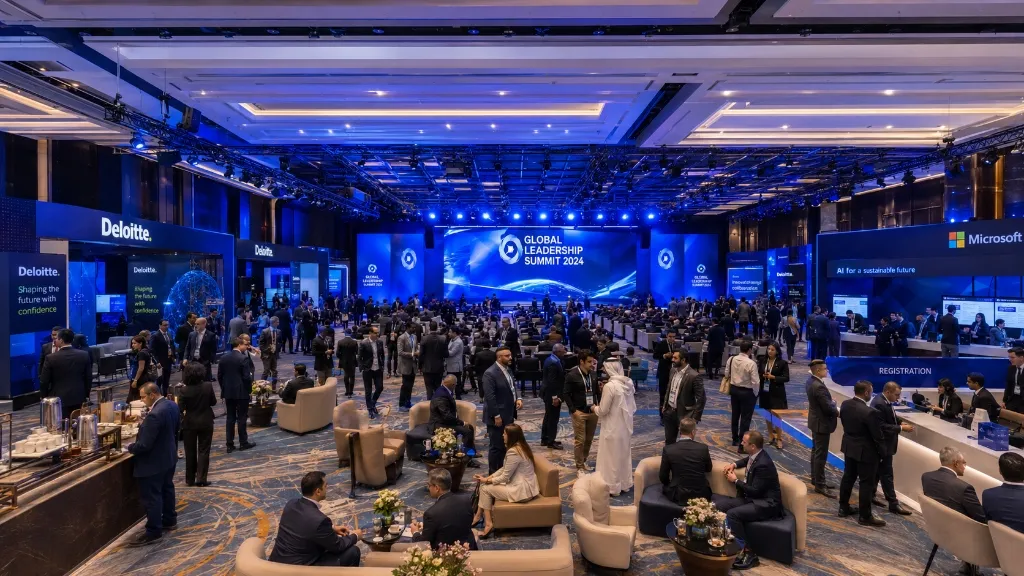
Direct Overview: There is no single correct staffing ratio for a corporate event. A 500-person ballroom conference, a 1,500-person leadership summit, and a multi-zone exhibition can require very different manpower structures even when attendance is similar. Staff requirements depend on venue geography, ingress windows, registration technology, VIP protocols, and the operational split between front-of-house hospitality and technical production support.
When planning corporate summits, annual general meetings, or partner conclaves across Delhi NCR and major Indian commercial hubs, corporate procurement and event marketing teams frequently ask: "How many event staff do I actually need?"
Relying on arbitrary rules of thumb—such as allocating one staff member for every 50 or 100 registered guests—is an operational mistake. Raw ratios ignore how attendees navigate physical spaces over time. Real-world event execution requires estimating manpower by mapping physical touchpoints, peak arrival curves, and operational zones across the venue.
Why Attendee Count Alone Is Not Enough
Calculating event manpower based purely on total attendance overlooks operational velocity. A 1,000-person event where guests arrive steadily across four hours requires a completely different staffing footprint than a 1,000-person keynote where 85% of delegates arrive within a 40-minute morning window.
Professional event manpower planning evaluates 14 interdependent operational variables:
- 1. Event Format: Seated plenary conferences require fewer directional staff than multi-track conventions with simultaneous breakout workshops and sponsor exhibition zones.
- 2. Ingress Velocity & Peak Arrival Curve: Compressed morning arrival windows demand higher check-in desk capacity to prevent lobby queuing.
- 3. Venue Layout & Architectural Footprint: Sprawling convention centers (such as Bharat Mandapam, Yashobhoomi, or JICC New Delhi) require more wayfinding personnel across long concourses than compact luxury hotel ballrooms (such as Taj Palace or ITC Maurya).
- 4. Registration Method: Automated QR self-scanning kiosks require fewer operators than manual list lookups, on-site badge printing, and delegate kit distributions.
- 5. Number of Entry Points: Separate parking gates, public foyers, and VIP drop-offs each require dedicated greeting and directional personnel.
- 6. Hospitality Requirements: Cloakrooms, luggage storage, directional escorts, gift bag distributions, and dining hall seating marshals all require assigned headcount.
- 7. VIP & CXO Protocols: Board members and keynote dignitaries require dedicated shadow escorts, private holding room management, and expedited registration.
- 8. Production Complexity: High-production stages with curved 4K LED backdrops, line-array audio, and multi-camera broadcasts require dedicated technical crews separate from hospitality staff.
- 9. Concurrent Breakout Sessions: Each active breakout hall needs a room coordinator to manage roving Q&A microphones, speaker timers, and room entry control.
- 10. Backstage Coordination: Managing speaker green rooms, lapel mic handovers, slide presentation checks, and emcee briefings demands dedicated backstage managers.
- 11. Transport & Fleet Logistics: Valet parking marshaling, coach boarding, and airport delegate reception desks require assigned transit personnel.
- 12. Security & Screening: Door Frame Metal Detectors (DFMD), bag inspection points, and security wristband checks require trained access-control personnel.
- 13. Event Duration & Shifts: An 8-hour executive meeting runs on a single shift, whereas a 14-hour summit requires staggered shift scheduling and relief rotations.
- 14. Simultaneous Activity Zones: When plenary sessions, exhibition booths, and dining halls operate concurrently, staff cannot be redeployed without creating blind spots.
The Main Event Staffing Categories
An enterprise event requires coordinating specialized providers—including front-of-house hospitality personnel, on-ground supervisors, and specialized technical production crews—rather than treating event staff as a single interchangeable workforce.
| Staffing Category | Primary Responsibilities | Core Skill Profile |
|---|---|---|
| Registration & Check-In | QR scanning, instant badge issuance, delegate kit handoff, queue management | Tech-literate, rapid data entry, high composure under pressure |
| Guest Reception & Hospitality | Main lobby welcome, executive greeting, directional wayfinding, information desk | Polished grooming, corporate etiquette, strong verbal fluency |
| Directional Ushers | Auditorium door control, seating zone guidance, aisle management, crowd flow | Proactive communication, physical stamina, situational awareness |
| VIP & Executive Hospitality | CXO greeting at VIP porch, private lounge hosting, stage escorting | High-touch protocol training, discreet diplomacy, professional presentation |
| On-Ground Zone Supervisors | Team roll-calls, shift rotations, break management, escalation handling, reporting | Operational leadership, crisis resolution, span-of-control discipline |
| Backstage Coordinators | Speaker green room briefing, presenter cueing, clicker handover, emcee support | Run-of-show familiarity, punctual timekeeping, calm stage-side demeanor |
| Technical Production Crew | Audio mixing, video switching, lighting consoles, LED processing, stage management | Certified AV engineers, riggers, lighting designers, technical directors |
| Brand Promoters & Demonstrators | Sponsor booth lead capture, product demonstration, brochure distribution | Active engagement, product familiarity, lead capture discipline |
| Logistics Runners | Material replenishment, badge ribbon restock, speaker hydration, errand transit | Speed, agility, backstage familiarity, rapid responsiveness |
| Transport & Fleet Marshals | Valet porch coordination, coach boarding, delegate airport greeting desks | Logistical tracking, chauffeur communication, schedule adherence |
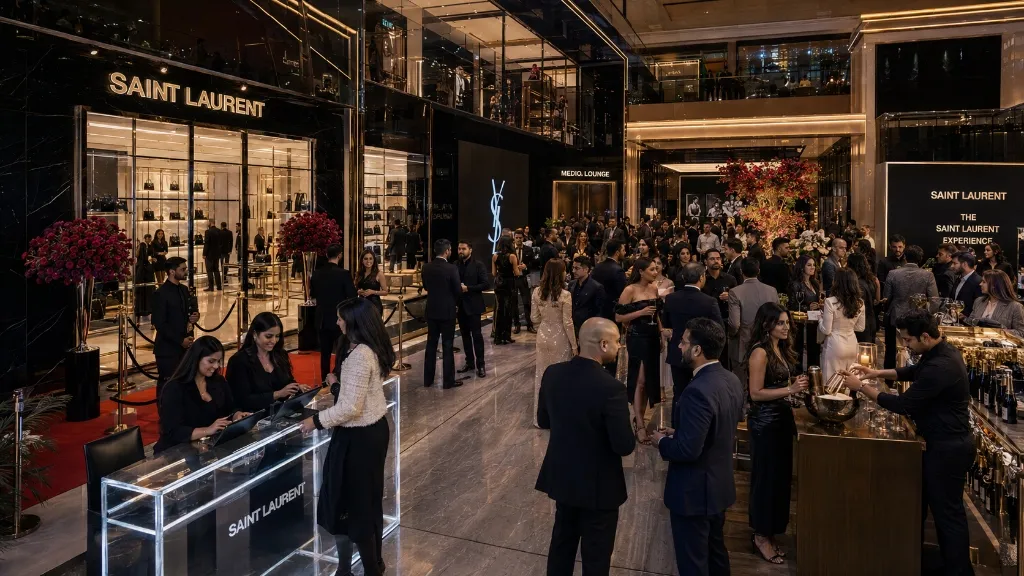
How to Estimate Staffing for a Corporate Event
Experienced event directors calculate staffing requirements using a structured six-step workflow:
- Map Physical Venue Nodes: Identify every point where attendees make decisions, register, or enter halls (drop-off, foyer, check-in, auditorium doors, breakout corridors, dining areas).
- Calculate Peak Throughput Rates: Model the arrival velocity. If 1,200 delegates arrive within a 45-minute window, you need capacity to process 27 attendees per minute across your registration desks.
- Isolate VIP & High-Touch Touchpoints: Allocate dedicated hostesses for VIP drop-off, reserved seating, and green rooms that cannot be reassigned when general registration surges.
- Separate Production Manpower from Hospitality: Build an independent crew roster for audio, video, lighting, and stage rigging operating under the Technical Director's master cue sheet.
- Apply Supervisor Span-of-Control: Assign one experienced supervisor for every 6 to 8 hospitality staff members to manage rotations, break schedules, and quality control.
- Incorporate a Standby Contingency Buffer: Add a 10% to 15% pre-briefed reserve pool to absorb sudden arrival spikes, transit delays, or unexpected team absences.
Illustrative Planning Models: 500 vs. 1,500 vs. 2,500 Delegates
The following planning models illustrate how staffing requirements scale across different corporate event formats and venue types. (Note: These figures represent illustrative planning benchmarks and should be adapted to your specific venue architecture and agenda.)
| Functional Role / Zone | 500 Delegates (Hotel Ballroom) | 1,500 Delegates (Corporate Summit) | 2,500 Delegates (Mega MICE / Convention) |
|---|---|---|---|
| Registration Desk (Operators & Queue) | 4 – 5 | 10 – 12 | 18 – 22 |
| Lobby Reception & Information | 2 | 4 | 6 – 8 |
| Directional Ushers & Wayfinding | 3 – 4 | 8 – 10 | 14 – 18 |
| Breakout Hall Coordinators | — (Single Track) | 6 (3 halls x 2) | 10 – 12 (5 tracks) |
| VIP & Speaker Hospitality Escorts | 2 | 4 – 5 | 6 – 8 |
| Backstage & Speaker Green Room | 1 – 2 | 3 – 4 | 4 – 6 |
| Transport & Valet Marshals | 1 – 2 | 3 – 4 | 4 – 6 |
| Logistics Runners | 2 | 4 | 6 – 8 |
| Dedicated On-Ground Supervisors | 1 – 2 | 3 – 4 | 5 – 6 |
| Total Front-of-House Hospitality Staff | 16 – 20 | 45 – 53 | 73 – 94 |
| Technical Production & AV Crew (FOH/Stage) | 6 – 8 | 14 – 18 | 26 – 34 |
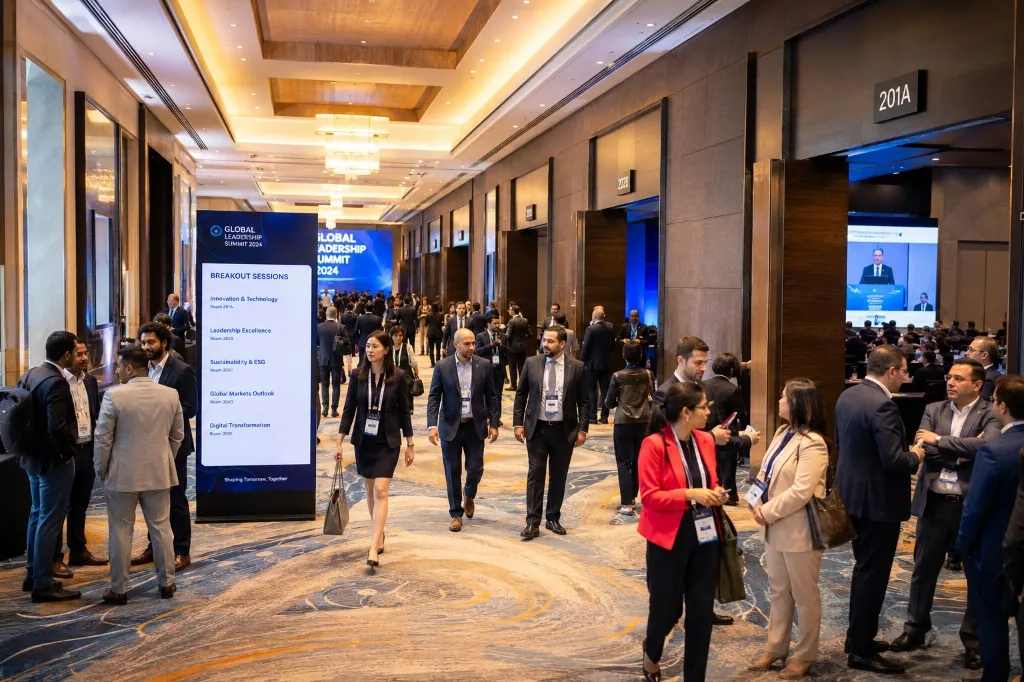
Registration and Ingress Staffing: Calculating Throughput
Registration counters are the most common operational bottleneck at corporate conferences. An undersized registration setup creates long queues that spill into venue driveways, delaying opening keynotes and compromising attendee sentiment.
To eliminate queues, registration staffing must be planned around peak transaction speed:
Throughput Calculation Formula:
Required Kiosks = (Peak Expected Attendees × Average Transaction Time in Seconds) / (Arrival Window in Minutes × 60)
If 1,200 delegates arrive within 45 minutes, and manual check-in takes 60 seconds per attendee, the math requires 27 concurrent registration desks—an impractical footprint for most hotel foyers.
At Aquila Events, our technical registration workflow solves this bottleneck by pairing digital QR passes with on-site thermal badge printing in under 3 seconds. By reducing complete transaction time (scan, badge print, and lanyard handover) to 12–15 seconds, each check-in terminal processes 4 to 5 attendees per minute. An array of 8 to 10 automated check-in bays comfortably clears 1,200 delegates in 35 to 40 minutes without queue buildup.
A well-structured corporate registration area requires five distinct role assignments:
- Queue Greeters & QR Marshals: Stationed at stanchion entry points to ensure attendees have digital confirmation QR codes ready on their phones.
- Terminal Check-In Operators: Scan codes, verify attendee credentials, and trigger instant thermal badge generation.
- Lanyard & Kit Handout Assistants: Hand over printed badges with branded lanyards and delegate programs.
- Dedicated VIP / CXO Desk: A fast-track desk where C-suite executives and keynote speakers receive pre-printed credentials with zero wait time.
- Troubleshooting & Query Desk: Positioned adjacent to main desks to redirect attendees with registration discrepancies, on-spot name edits, or payment queries away from primary throughput lanes.
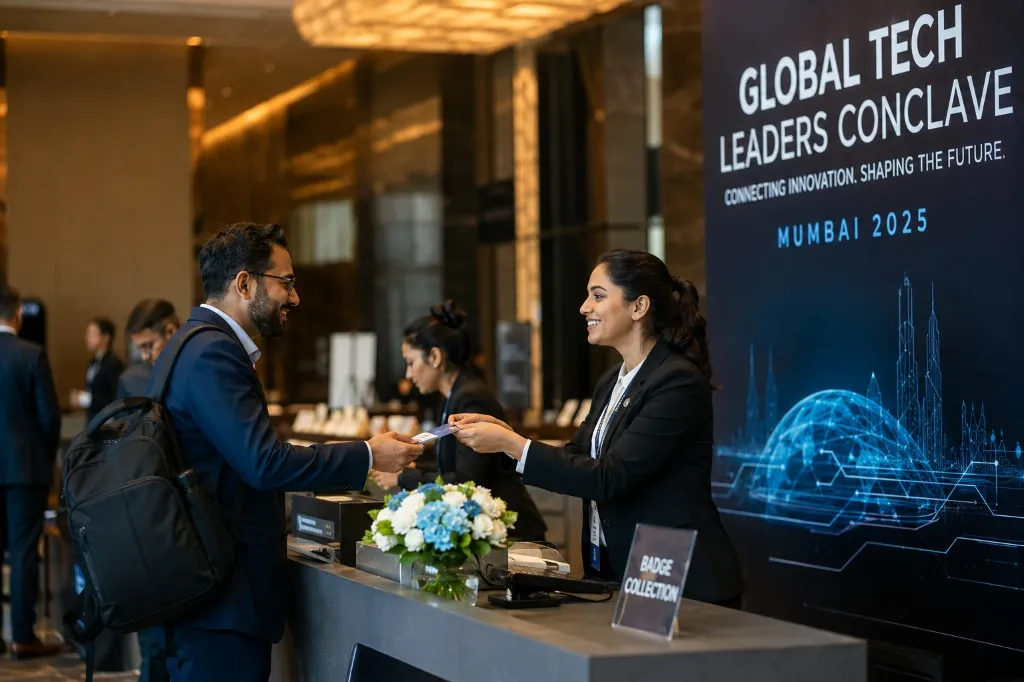
Why Supervisors Matter: Span of Control and Event Accountability
Deploying dozens of hostesses and ushers without an adequate supervisory layer is a common organizational failure in corporate event management. Individual crew members focus on immediate tasks; they lack authority to manage breaks, resolve cross-zone bottlenecks, or interface with client executives.
In high-stakes event operations, supervisors enforce the span-of-control principle: a single team lead manages no more than 6 to 8 crew members or oversees one contained physical zone (such as the Registration Lobby, Main Plenary Hall, or VIP Lounge).
Key responsibilities of dedicated On-Ground Event Supervisors include:
- Pre-Event Roll-Call & Grooming Inspection: Assembling crew 90 minutes before doors open, conducting grooming checks (uniform standards, hair, makeup, corporate footwear), and testing scanners and radios.
- Shift & Relief Rotation Management: Ensuring staff receive scheduled hydration and meal breaks without leaving critical doorways or registration desks unstaffed.
- Rapid Standby Deployment: Replacing any crew member encountering illness or transit delays with pre-briefed reserve personnel.
- Single Point of Contact (SPOC): Serving as the communication bridge between corporate procurement leads and on-ground personnel, shielding organizers from low-level operational noise.
- Real-Time Telemetry & Reporting: Tracking live check-in volumes, monitoring hall capacities, and delivering hourly attendance updates to the organizing committee.
Production Manpower vs. Hospitality Manpower: The Essential Distinction
A frequent point of confusion for corporate event buyers is the operational boundary between event hospitality staff and technical event production crews. While working in the same venue, they belong to fundamentally different professional domains (for a technical breakdown of production roles and procurement criteria, see our guide on how to choose an event production company in Delhi NCR):
| Parameter | Hospitality & Operations Manpower | Technical Event Production Crew |
|---|---|---|
| Primary Focus | Guest welcome, registration, ushering, VIP protocol, wayfinding, delegate support | Stage engineering, line-array audio, curved LED video, lighting design, live show direction |
| Reporting Line | On-Ground Hospitality Supervisor → Operations Director | Technical Director (Show Caller) → Production Head |
| Core Roles | Registration hostesses, VIP escorts, ushers, concierges, promoters, floor runners | FOH Audio Engineers (A1/A2), Video Switchers (V1), Lighting Programmers (L1), Riggers |
| Operating Tools | Mobile scanners, thermal badge printers, walkie-talkies, attendee muster lists | Digital mixing consoles, master video switchers, lighting boards, intercom matrices |
| Execution Framework | Crowd flow dynamics, customer service etiquette, greeting protocol | Minute-by-minute cue sheets, electrical load balancing, acoustic modeling, RF spectrum plans |
Attempting to cross-utilize these roles—such as asking AV technicians to manage attendee check-in or asking registration hostesses to manage backstage cabling—creates severe operational hazards. While hospitality manpower ensures seamless guest navigation, the technical backbone of an enterprise summit requires dedicated audio, video, lighting, and stage engineering specialists. For an in-depth technical breakdown of line arrays, curved LED displays, dual-redundant power, and cue-calling direction, explore our companion blueprint to corporate event production in Delhi NCR.
What Happens When Staffing Is Underestimated? Real-World Failure Modes
When corporate planners cut staffing budgets to reduce line-item expenses, operational breakdowns surface quickly during live execution:
- Registration Driveway Choke Points: Understaffed check-in desks cause queues to spill into hotel drop-off porches, causing traffic gridlock and delaying inaugural CEO keynotes by 30 to 45 minutes.
- Unescorted VIPs and Speaker Misplacement: When VIP escorts are omitted, senior executives and keynote speakers arrive unguided, wander into general seating, or miss their pre-speech audio mic checks in the green room.
- Breakout Session Disarray: Without room coordinators, breakout halls experience chaotic seating overflow, audio lapels are not switched between panelists, and roving microphones are absent during audience Q&A sessions.
- Post Abandonment Due to Fatigue: When staffing plans lack scheduled relief rotations, hostesses standing for 8+ consecutive hours without breaks suffer fatigue, leading to deserted registration counters and unmonitored auditorium doors.
- Supervisor Blind Spots: When a single coordinator attempts to manage 40+ crew members across multiple convention levels, they spend their day firefighting isolated issues while losing overall situational awareness of the event.
How to Brief an Event Staffing Partner: A Practical Procurement Checklist
To receive an accurate, reliable manpower proposal, corporate procurement managers and event organizers should provide a comprehensive operational brief covering 10 essential criteria (for wider budget planning, see our corporate event budget breakdown for Delhi NCR):
Event Staffing Briefing Matrix:
- 1. Event Parameters: Exact dates, city, venue name, and specific halls or lawns booked.
- 2. Attendance Profile: Total expected attendees, estimated VIP/CXO headcount, and anticipated arrival window curve.
- 3. Shift Timings & Call Times: Crew call time (typically 90 minutes before doors open), briefing schedule, show operational window, and expected strike time.
- 4. Role Matrix by Physical Zone: Headcount requests allocated across Registration, Lobby Ingress, Auditorium Seating, Breakouts, VIP Lounge, and Backstage.
- 5. Language & Profile Requirements: Required fluency (e.g., bilingual English/Hindi, regional language capabilities for national delegate conclaves), grooming standards, and prior corporate conference experience.
- 6. Uniform & Presentation Standards: Formal western business suits, branded blazers, corporate sarees, or smart casual attire, specifying whether uniforms are client-provided or vendor-supplied.
- 7. Supervisory Hierarchy: Requirement for dedicated on-ground supervisors and designated single points of contact (SPOCs).
- 8. Attendance Verification Technology: Preferred tracking methods (digital GPS mobile check-ins, barcode scanning, or manual muster logs).
- 9. Standby Contingency Buffer: Contractual commitment for 10% to 15% pre-briefed backup manpower on standby for immediate deployment.
- 10. Staff Welfare Logistics: Provision of dedicated staff rest areas, drinking water access, and scheduled meal catering during extended shifts.
How Aquila Approaches Event Staffing & Manpower Management
At Aquila Events, we approach on-ground event manpower not as temporary commoditized labor, but as an integrated operational discipline essential to executive brand reputation. Through our strategic integration with Promotr, India's leading event workforce technology platform, we deliver verified corporate event staffing across 20+ major commercial centers—including Delhi NCR, Mumbai, Bengaluru, Hyderabad, and Jaipur.
Our workforce management architecture provides enterprise clients with verified operational safeguards:
- Vetted Professional Profiles: Every hostess, registration coordinator, and supervisor is vetted through performance histories, past event ratings, and grooming standards.
- Digital Attendance & GPS Telemetry: Crew arrivals, shift check-ins, and post assignments are tracked digitally, providing corporate clients with transparent real-time manpower verification.
- Structured Zone Supervision: Our experienced team leads maintain strict span-of-control ratios, coordinating break rotations, handling guest escalations, and enforcing corporate protocol on the floor.
- Seamless Production Integration: Because we execute turnkey technical event production and corporate event management under one roof, our hospitality teams and technical FOH crews operate in complete synchronization.
This integrated methodology has powered landmark enterprise gatherings across premier Indian venues, including:
- National Leadership Summit at Taj Palace, New Delhi: Turnkey staging, curved 4K LED, and seamless delegate hospitality operations for 1,200 senior executives.
- International MICE Conclave at JICC, New Delhi: Mega convention production, multi-track breakout coordination, and high-throughput digital ingress management for 2,500 global attendees.
Learn more about our verified on-ground capabilities by visiting our dedicated Event Staffing & Manpower Services page.
A Corporate Event Staffing Checklist
Use this chronological operational checklist to ensure your event staffing deployment is structured, verified, and ready for show day:
| Milestone | Operational Focus | Key Action Items |
|---|---|---|
| T-14 Days | Staffing Roster & Profile Vetting | Finalize zone headcounts, approve hostess profiles, verify language requirements, lock uniform dress code. |
| T-7 Days | Operational Briefing Document | Draft detailed role matrix, map registration flow diagrams, confirm shift meal arrangements and staff room locations. |
| T-48 Hours | Credentialing & Tech Alignment | Test thermal badge printers, configure QR barcode scanners, verify radio frequency channels with venue security. |
| T-90 Minutes (Show Day) | Morning Roll-Call & Briefing | On-ground supervisor conducts attendance check, inspects grooming standards, tests comms, deploys standby reserves if needed. |
| T-15 Minutes (Doors Open) | Post Deployment & Radio Check | All ushers, registration teams, and VIP escorts stationed at physical posts; final walkthrough with client lead. |
| Live Show Window | Dynamic Flow & Break Rotation | Supervisors manage staggered meal rotations, monitor hall capacities, and track real-time attendance telemetry. |
| T+1 Day | Reconciliation & Debrief | Collate final attendee check-in analytics, conduct supervisor debrief, reconcile badges and event hardware. |
Frequently Asked Questions About Corporate Event Staffing
For a single-track 500-person conference in a hotel ballroom, organizers typically deploy 12 to 16 front-of-house hospitality personnel (4–5 registration hostesses, 3–4 ushers, 2 VIP escorts, 1–2 runners, and 1–2 zone supervisors), alongside a dedicated technical production crew of 6 to 8 engineers. If the event includes concurrent breakout tracks, staffing requirements scale accordingly.
Divide your peak arrival volume (typically 75% to 80% of delegates) by the arrival window in minutes, then divide by your per-kiosk throughput. Using automated QR scanning and on-site thermal badge printing in under 3 seconds, each check-in terminal processes 4 to 5 guests per minute, meaning 8 to 10 automated bays smoothly clear 1,200 delegates within 35 to 40 minutes.
Yes. Supervisors maintain operational span of control (typically 1 supervisor per 6 to 8 crew members), enforce grooming standards, coordinate scheduled relief breaks, monitor attendance telemetry, and resolve escalations so event organizers do not spend show hours managing individual desk queries.
Event hospitality staff manage guest-facing touchpoints (registration, ushering, VIP greeting, wayfinding, and delegate support). Production crews are specialized technical engineers who operate stage rigging, line-array audio, curved LED video switching, lighting consoles, and live show calling.
Yes. Enterprise event plans should always maintain a 10% to 15% pre-briefed standby replacement buffer. This protects the event against travel delays, last-minute sickness, or unexpected delegate surges without leaving registration gates or VIP suites unstaffed.
Event staff are directed by an on-ground Lead Supervisor or Operations Lead provided by the staffing agency, acting as the single point of contact (SPOC) for the corporate client. The SPOC conducts morning roll-calls, enforces shift rotations, and provides live check-in updates.
For corporate summits needing 15 to 30 crew members, a 2 to 3-week lead time allows proper profile vetting, language screening, and uniform fitting. For large conventions requiring 50+ hostesses across venues like Bharat Mandapam, JICC, or Yashobhoomi, a 4 to 5-week window is recommended.
Yes. Turnkey agencies like Aquila Events bridge technical production with on-ground workforce management. Through workforce platforms like Promotr, we integrate front-of-house hospitality hostesses with backstage AV crews under unified cue sheets and synchronized show direction.
Planning On-Ground Staffing for an Upcoming Corporate Event?
Consult directly with our event operations team for custom manpower planning, registration throughput modeling, and verified corporate hostesses across India.
Ready to Produce Your Next Event?
Consult directly with our technical event architects for turnkey production, staging, and logistics across India.