
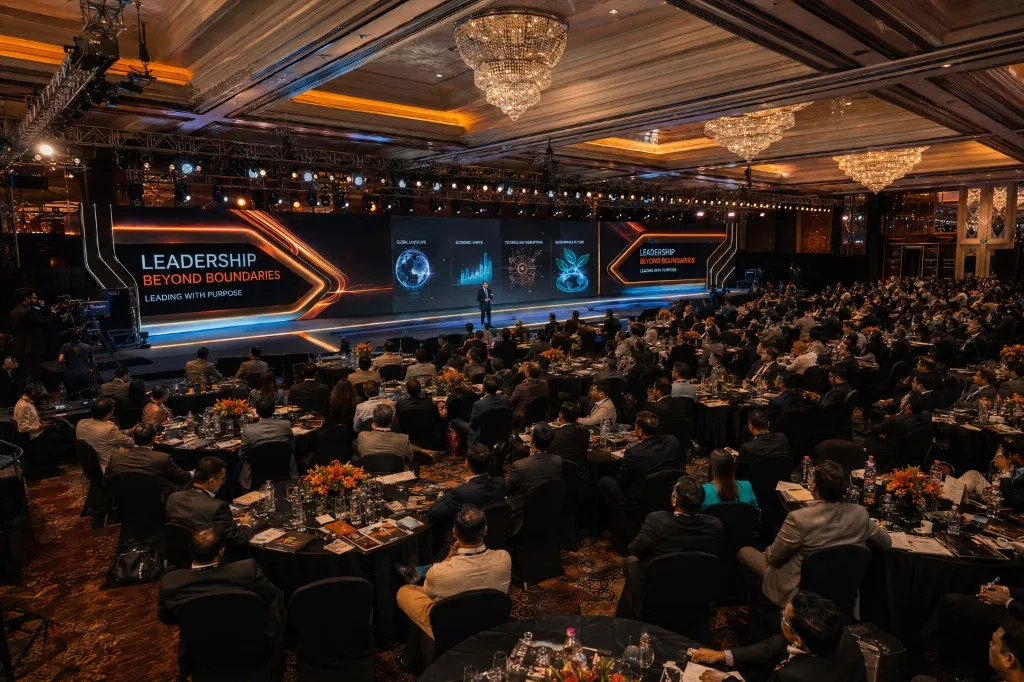
Executing an enterprise leadership summit, annual general meeting, or cross-border convention requires more than aesthetic decor. When a company gathers 1,000 to 2,500 senior executives, investors, global partners, and institutional stakeholders in a single venue, the technical and logistical tolerances approach zero. A 20-second audio dropout during a CEO keynote, a frozen video slide deck, or a 45-minute bottleneck at morning registration can compromise brand reputation and undermine business objectives.
Executive Summary: End-to-end corporate event production in Delhi NCR encompasses the turnkey engineering of physical staging, acoustic design, high-resolution visual displays, dual-redundant power infrastructure, and on-ground show direction for high-stakes enterprise gatherings. It bridges spatial design at premier venues—from luxury hotel ballrooms like Taj Palace and ITC Maurya to mega convention complexes like Bharat Mandapam and Yashobhoomi—with rigorous technical execution, regulatory statutory compliance, and zero-latency attendee ingress. At Aquila Events, our production architecture ensures seamless keynote delivery, brand elevation, and flawless operational synchronization across every minute of the run-of-show.
Whether producing an industry conference at Delhi NCR's landmark convention centers or hosting an elite executive gala in a premier hotel ballroom, planning must be grounded in structural engineering, electrical redundancy, acoustic precision, and disciplined run-of-show direction. This operational blueprint outlines how high-stakes events are systematically planned and delivered across the National Capital Region.
The 8 Critical Layers of High-Stakes Corporate Event Production
A corporate production is an integrated system of interdependent disciplines. When any single subsystem fails, the impact cascades across the entire attendee experience. At Aquila Events, our turnkey corporate event management and technical event production frameworks break execution into eight distinct operational layers.
Layer 1: Staging & Scenography
Staging serves as the physical foundation of the event environment. In corporate summits, stage design must balance structural safety, sightline geometry, and camera framing:
- Structural Load Engineering: Certified modular aluminum box trussing engineered to support overhead video walls, lighting rigs, and suspended audio clusters. Every suspension point undergoes weight distribution verification against venue rigging load limits.
- Deck Height vs. Sightline Geometry: Stage elevation is calculated relative to ballroom depth. For a hall accommodating 1,200 delegates seated theater-style over 120 feet, a 3.5ft to 4ft deck height is mandatory to maintain unobstructed visibility from row 10 backward without causing neck strain in rows 1 through 3.
- Surface & Fascia Finishes: Stage decks utilize high-density composite timber underlayment with matte-finish architectural laminates. High-gloss vinyl or reflective wraps are avoided because they cause harsh glare under broadcast lighting and reflect on-camera artifacts onto LED displays.
- Clear-Span Structures: For large-scale outdoor activations, temporary exhibition pavilions, or overflow dining setups, engineered clear-span structures with site-specific wind-load ratings and flame-retardant heavy-duty membranes are deployed.
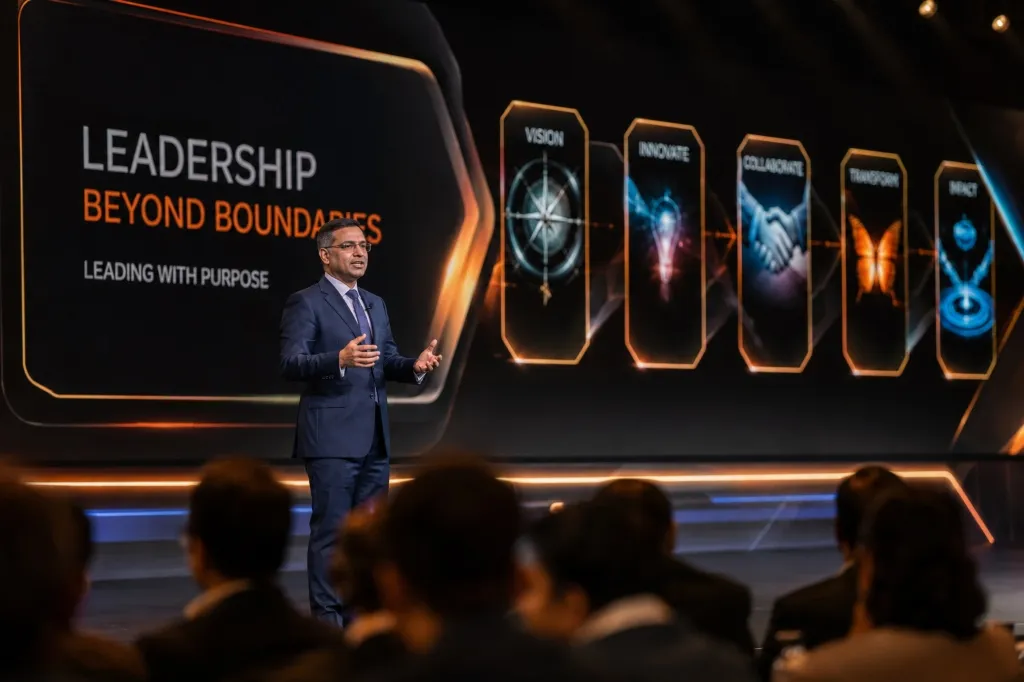
Layer 2: Audio Engineering & Acoustics
Speech intelligibility is the most critical technical parameter in any corporate conference. If delegates strain to understand a keynote speaker or if microphones feed back, the event's credibility is damaged instantly:
- Acoustic Venue Modeling: Prior to load-in, ballrooms are mapped using 3D acoustic simulation software (L-Acoustics Soundvision or d&b ArrayCalc) to analyze Early Decay Time (EDT) and reverberation profiles, accounting for high ceilings, glass perimeter walls, and carpeted floors.
- Line-Array Deployment & Delay Zones: Rather than relying on high-output point-source speakers at the front, we deploy dual line-array hangs utilizing tier-1 touring platforms (such as L-Acoustics or d&b audiotechnik systems) paired with time-aligned delay speaker columns positioned every 18 to 22 meters. This guarantees uniform Sound Pressure Levels (SPL) within ±2 dB from the front row to the rear exit doors.
- RF Wireless Management: Corporate venues and high-density hospitality corridors in Delhi NCR present exceptionally dense radio frequency environments with localized interference and administrative constraints. We deploy broadcast-grade digital wireless microphone systems with multi-zone antenna distribution, paired with active pre-event spectrum scans and coordinated frequency planning to eliminate RF interference, dropouts, and intermodulation distortion.
- Automated Speech Mixing: Professional digital mixing consoles equipped with automated speech mixing algorithms automatically attenuate inactive panel microphones, eliminating comb filtering and room noise buildup during multi-speaker CXO panel discussions.
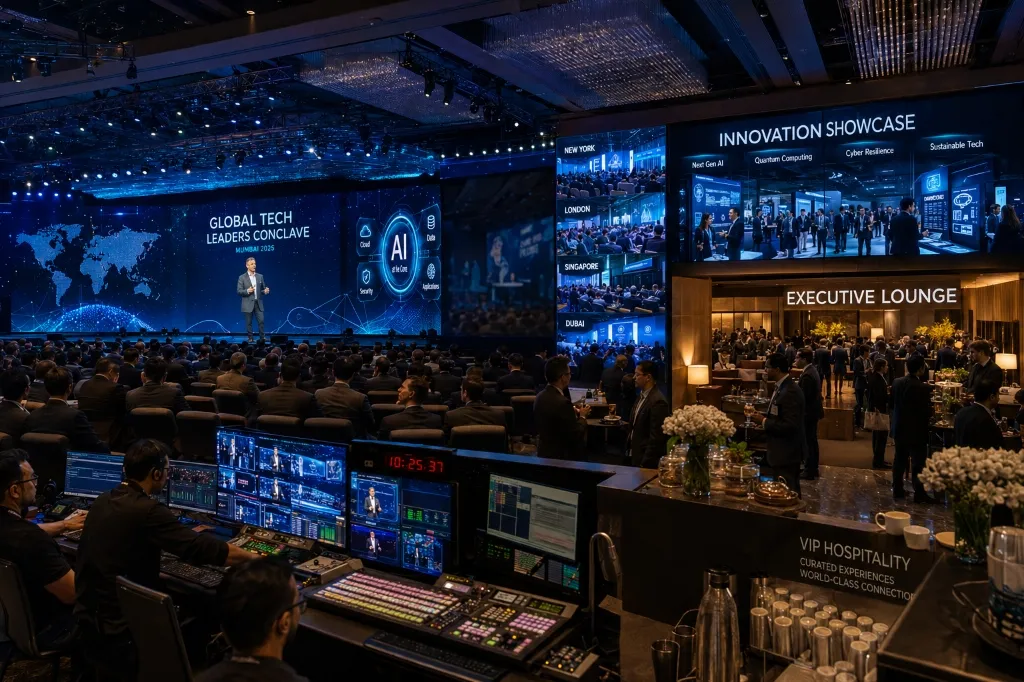
Layer 3: Visual & LED Display Architecture
The visual canvas carries the keynote narrative, video reels, and financial presentations. Corporate visual architecture demands broadcast-grade switching and ultra-high pixel density:
- Fine Pixel Pitch (P1.9 to P2.6): For indoor corporate plenary stages where front-row attendees sit within 4 to 6 meters of the screen, we deploy high-refresh P1.9 to P2.6 indoor LED panels. This eliminates visible moiré patterns during photo and video capture and ensures fine typographic text in financial charts remains razor-sharp.
- Curved Panoramic Geometries: Curved concave LED backdrops (3° to 5° curve per column) envelop audience sightlines, creating an immersive focal point while reducing off-axis color shifts.
- Presentation Management & Seamless Switching: Tier-1 master screen management processors (such as Barco or Analog Way platforms) handle multi-window PIPs, lower-thirds, and live camera tracking with seamless hardware cut-busses.
- Synchronized Graphics Workstations: Primary and backup presentation workstations running Keynote and PowerPoint are synchronized with master wireless cueing systems, feeding hardware failover switches that provide seamless auto-transfer if a machine encounters an operating system freeze.
- Confidence Monitoring & Teleprompters: Dual 55-inch 4K Downstage Monitors (DSM) placed at the stage lip provide presenters with remaining timers, current slides, and upcoming notes. Presidential glass teleprompter pairs flanking the podium give C-suite executives natural, confident eye contact with the audience.
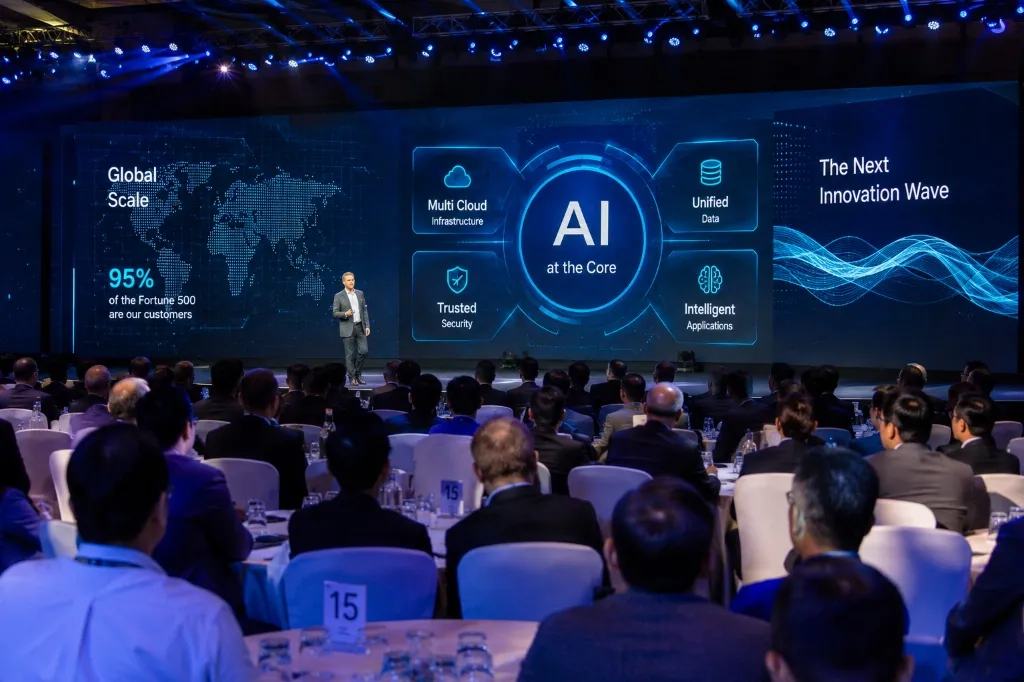
Layer 4: Stage & Ambient Lighting
Lighting in a corporate summit must flatter speakers, illuminate branding, and support high-definition video recording without washing out LED displays:
- Broadcast-Grade Key Lighting: High-CRI fixtures (Color Rendering Index > 95, TLCI > 96), including precision profile fixtures and soft broadcast panels, provide uniform, flicker-free key lighting calibrated to 5600K daylight or 3200K tungsten balance.
- Profile Framing & Shutter Cutoffs: Four-blade internal framing shutters precisely isolate the speaker lectern, preventing stray light beams from hitting the LED wall and degrading contrast ratios.
- Wash Fixtures & Moving Profiles: Quiet moving head wash fixtures provide subtle stage warmth, while profile moving heads are programmed for dynamic walk-on stingers and award reveals without blinding attendees.
- Glare Reduction: Beam angles are locked at 45 degrees to illuminate faces clearly while preventing direct glare into the eyes of presenters using presidential teleprompters.
Layer 5: Power Architecture & Redundancy
Commercial venue utility power can fluctuate during peak afternoon demand or air conditioning load surges. A corporate production cannot rely on unprotected building mains:
- Synchronized Dual DG Sets: Two silent acoustic-enclosed diesel generator sets (e.g., 2x 250 kVA or 2x 320 kVA) operating in synchronized load-sharing or Auto-Mains Failure (AMF) hot-standby configuration guarantee uninterrupted power if one generator experiences a mechanical fault.
- Segregation of Clean vs. Dirty Power: Strict physical circuit segregation ensures sensitive audio consoles, digital signal processors, LED sending cards, and broadcast gear operate on dedicated 'clean power' distribution boards, isolated from inductive lighting loads, motor hoists, and catering equipment.
- Online Double-Conversion UPS Systems: Centralized 20 kVA to 40 kVA online double-conversion battery UPS systems buffer the Front-of-House (FOH) console village and video processing racks, providing pure sine-wave electricity with zero transfer delay.
Layer 6: Guest Flow, Registration & Digital Ingress
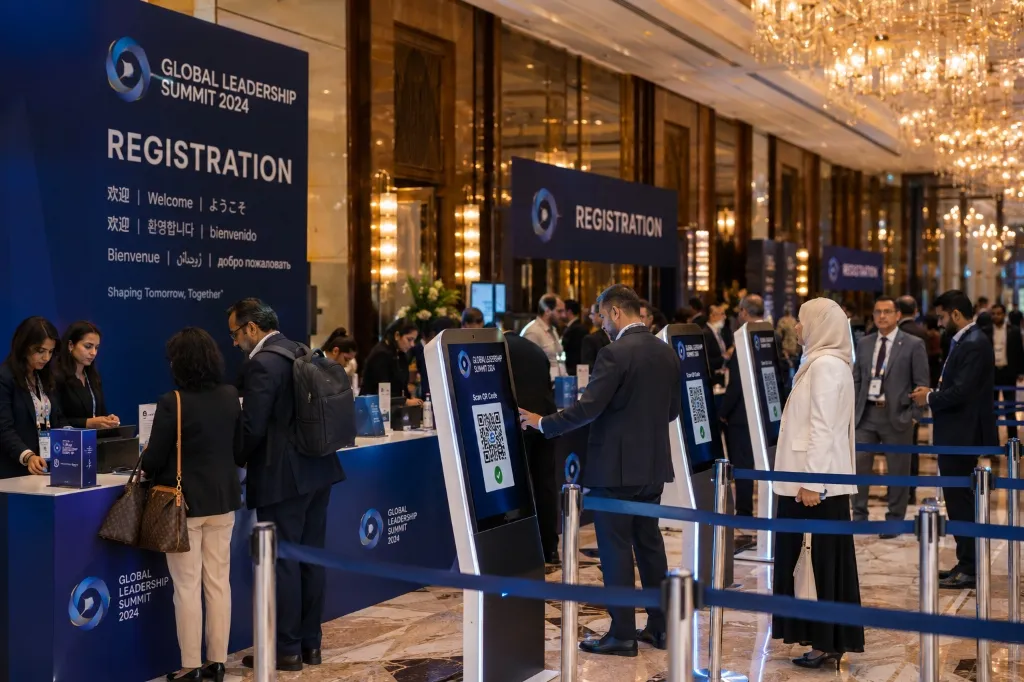
First impressions form at the registration desk. Ingress operations must process large delegate volumes rapidly and securely:
- High-Speed Thermal Badge Printing: Industrial high-speed thermal badge printers generate personalized, tear-resistant badges with encoded QR codes in under 3 seconds per attendee upon scanning their pre-event registration pass.
- Throughput Capacity Engineering: For a 1,500-delegate summit where 80% of guests arrive within a 45-minute window, a minimum of 10 to 12 parallel check-in bays is required to keep individual wait times below 90 seconds.
- Zoned Ingress Lanes: Physical separation of General Delegates, Media/Press, Keynote Speakers, and VIP/CXO convoys prevents cross-traffic congestion at the lobby entry gates.
- Security Screening: Integration of Door Frame Metal Detectors (DFMD), baggage X-ray scanners, and discrete cloakrooms managed by trained event staffing professionals.
Layer 7: Show Direction & Run-of-Show
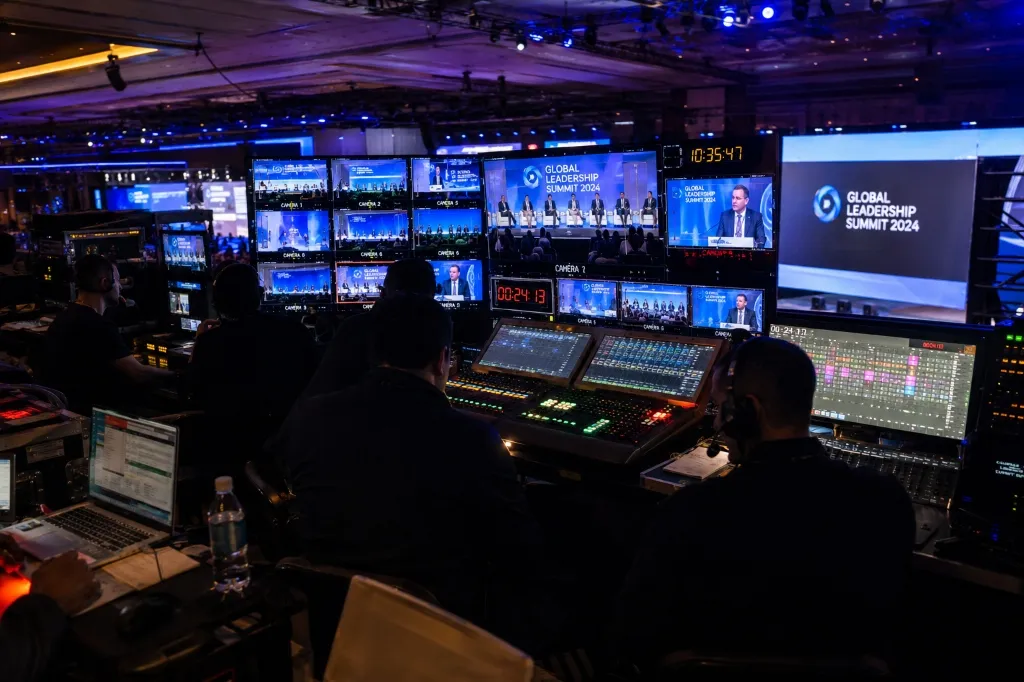
A flawless technical rig is ineffective without disciplined show direction. The Technical Director acts as the air traffic controller of the event:
- Minute-by-Minute Master Cue Sheet: A unified operational document mapping exact timestamps, session titles, speaker names, audio channels, visual slide inputs, lighting cues, teleprompter pages, and stage management prompts.
- Full-Duplex Intercom Networks: Production crews communicate via closed multi-channel wireless matrix intercoms, separating audio, video, stage, and hospitality chatter onto discrete channels.
- Green Room Speaker Coordination: Dedicated backstage coordinators brief speakers 15 minutes prior to their stage entrance, checking mic placement, clicker familiarity, and session timing.
- Whisper Talkback: Private stage-side communication channels allow the Show Caller to cue stage managers and emcees without audible bleed into the ballroom.
Layer 8: Statutory Permissions & Venue Compliance in Delhi NCR
Navigating municipal, administrative, and venue regulations in Delhi NCR requires strict foresight:
- Delhi Fire Service (DFS) & Life Safety Guidelines: Structural compliance requiring certified flame-retardant fabrics on all stage drapes, unobstructed emergency egress corridors sized and maintained in accordance with venue occupancy requirements, applicable fire-safety approvals, and relevant National Building Code standards, along with readily accessible fire extinguishers at backstage power nodes.
- CPCB & Ambient Noise Regulations: Applicable Central Pollution Control Board and Noise Pollution Rules requirements govern ambient noise at the relevant property boundary, while indoor ballrooms require acoustic containment, directional sound design, and venue-specific controls. Outdoor amplified sound must comply with applicable local restrictions, including the 10:00 PM to 6:00 AM restriction under the Noise Pollution Rules where applicable.
- Venue Loading Dock Protocols: Five-star hotels in New Delhi (such as Taj Palace on Sardar Patel Marg or ITC Maurya in the Diplomatic Enclave) enforce strict freight dock booking windows and vehicle size restrictions. Heavy commercial vehicles must also comply with Delhi traffic police entry restrictions on NH-48 and inner ring roads.
- Structural Safety Certificates: Flown trusses and ground-support roof systems require safety load clearance certificates signed by a licensed chartered structural engineer before commissioning.
Step-by-Step Production Planning Workflow: T-12 Weeks to T+1 Day
Executing high-stakes corporate productions requires a disciplined planning horizon. The following phased timeline illustrates the milestone progression for an enterprise summit:
| Timeline | Production Milestone | Key Deliverables & Action Items |
|---|---|---|
| T-12 to T-8 Weeks | Scoping, Venue Feasibility & RFP | Define delegate capacity, ballroom acoustic survey, venue freight dock inspection, electrical load audit, and preliminary technical rider formulation. |
| T-6 to T-4 Weeks | 3D Spatial Design & Technical CAD | Deliver photorealistic 3D stage renders, sightline CAD cross-sections, LED raster mapping, line-array acoustic simulation, and vendor procurement locks. |
| T-2 Weeks to T-7 Days | Fabrication Approval & Cue Sheet Drafting | Sign off on stage set construction mockups, verify presentation media in native 16:9 aspect ratios, finalize master cue sheet, and submit municipal NOC filings. |
| T-48 to T-24 Hours | Load-In, Rigging & Technical Calibration | Overnight freight load-in, truss motor hoisting, curved LED assembly, line-array time-alignment, RF spectrum scanning, and full technical dry run. |
| T-0 (Show Day) | Live Execution & Show Direction | 06:00 AM comms and power check, zero-queue digital registration open, live cue-calling from FOH, contingency standby, and VIP green room hospitality. |
| T+1 Day | Safe Strike, Reconciliation & Debrief | Controlled overnight de-rigging, venue handover inspection, delegate attendance analytics reporting, and executive client debrief. |
Common Failure Modes in Delhi NCR Corporate Events (and How to Prevent Them)
Understanding where corporate productions typically falter is essential to building resilient operational safeguards. Below are the six most common failure modes observed in Delhi NCR events and their engineering remedies:
1. Audio Feedback and Phase Cancellation During Keynotes
The Failure: A high-pitched squeal pierces the ballroom when a CXO steps from behind the lectern toward the center stage, or words sound muffled in the rear seating rows.
The Root Cause: Omnidirectional lapel microphones picking up audio reflections from stage monitors or front line-array speakers, coupled with lack of time-aligned delay speakers.
The Prevention: We deploy cardioid or subminiature directional headset microphones, utilize automatic feedback suppression with dynamic notch filters on digital consoles, and calibrate time-aligned delay speaker clusters so sound arrives in phase across every seat.
2. Video Signal Blackouts and Presentation Laptop Crashes
The Failure: A keynote speaker clicks to advance their presentation, the screen goes black for 4 seconds, or their slide deck appears stretched with distorted typography.
The Root Cause: Running slides directly from a speaker's untested personal laptop via HDMI cables without hardware EDID emulation, or aspect ratio mismatches between 4:3 legacy decks and 16:9 displays.
The Prevention: All presenter decks are collected 2 hours prior by our graphics hub, checked for font compatibility, and loaded onto matched primary and backup workstations. Video signals pass through master presentation switchers (such as Barco E2 or equivalent hardware) with locked EDID handshakes and instantaneous hardware failover.
3. Electrical Circuit Trips and Stage Blackouts
The Failure: Mid-way through an afternoon presentation, the main LED backdrop and stage lights flicker and shut down simultaneously.
The Root Cause: Power overload caused by sharing the same circuit breaker between stage production, heavy hotel kitchen warmer equipment, and ballroom HVAC chillers.
The Prevention: We never draw primary production power from shared venue wall sockets. We install dedicated, acoustic-enclosed synchronized dual DG sets with dedicated clean power distribution boards and battery-backed online UPS units on all digital consoles and processors.
4. Ingress Choke Points at Morning Registration
The Failure: A 200-meter queue snakes out into the hotel driveway at 08:45 AM, delaying the inaugural plenary session by 40 minutes.
The Root Cause: Manual paper attendee lists or slow consumer-grade printers that take 30 to 45 seconds per badge.
The Prevention: Pre-event digital passes with QR codes sent via WhatsApp and email, paired with industrial high-speed thermal badge printers delivering badges in under 3 seconds per guest across 12 dedicated check-in bays.
5. Freight Loading Dock Bottlenecks
The Failure: Stage fabrication materials are delayed outside the venue loading dock at 02:00 AM, shrinking technical rehearsal time to under 30 minutes before doors open.
The Root Cause: Uncoordinated arrival of multiple freight trucks competing for a single freight elevator in high-security hotels like Taj Palace or ITC Maurya.
The Prevention: A staged load-in schedule coordinated 2 weeks in advance with venue security, pre-fabricating modular stage components off-site so assembly requires only mechanical joining rather than on-site carpentry.
6. Delhi NCR Seasonal Externalities
The Failure: Flights carrying keynote speakers are delayed by dense winter fog at IGI Airport, or severe monsoon downpours flood access roads and venue outdoor pre-function areas.
The Root Cause: Lack of environmental and municipal buffer planning specific to Delhi NCR seasonal weather patterns.
The Prevention: For winter conferences (December–January), keynote speakers are scheduled to arrive the preceding afternoon, and remote video conference links (vMix / Zoom ISO) are configured as hot backups. For monsoon periods, covered clear-span structures with elevated waterproof flooring and submersible sump pumps protect all outdoor pathways.
Event Staffing & On-Ground Team Structure
Flawless execution requires clear chain-of-command protocols on the ground. A typical 1,000+ delegate corporate conference requires a specialized technical crew managed through clear hierarchical communication (for an operational guide on front-of-house headcounts, registration desks, and supervisor ratios, see our guide to corporate event staffing requirements):
- Technical Director (Show Caller): The central authority seated at FOH. Calls every cue—audio transitions, video rolls, lighting changes, teleprompter pages, and stage movements—over the master intercom.
- Stage Manager & Deck Captain: Controls the physical stage perimeter, oversees speaker movements, ensures lectern microphones are sanitized and tested, and coordinates stage hospitality.
- Lead Audio Engineer (FOH A1): Mixes live ballroom audio, balances speaker intelligibility, controls dynamic EQ, monitors RF spectrum health, and manages audio recording feeds.
- Master Video Systems Engineer (V1): Operates the master presentation switcher, manages multi-screen routing, supervises live camera feeds, and triggers graphics transitions.
- Lighting Designer & Console Programmer (L1): Operates the professional lighting console, maintains broadcast-balanced key lighting on speakers, and triggers cue sequences.
- Ingress & Registration Lead: Manages check-in terminal infrastructure, oversees hostess staffing, resolves delegate badge queries, and provides real-time attendance telemetry to organizers.
- Rigging & Structural Safety Marshal: Inspects all overhead truss clamps, safety wire backups, baseplate ballast weights, and emergency exit clearances.
- Power Systems Engineer: Monitors generator fuel levels, voltage stability, phase balance telemetry, and UPS battery readiness throughout the show.
How to Evaluate an Event Production Partner in Delhi NCR
When selecting a production partner for an enterprise conference, corporate procurement and leadership teams should evaluate vendors against five operational criteria (for an in-depth RFP checklist, see our guide on how to choose an event production company in Delhi NCR):
Vendor Evaluation Checklist:
- 1. Dedicated In-House Technical Design: Does the agency provide precise 3D CAD spatial renders, sightline studies, and acoustic simulation models, or do they merely act as an intermediary broker subcontracting work to unvetted third parties?
- 2. Tier-1 Hardware Standards: Inspect the proposed equipment inventory. Insist on Tier-1 industry-standard hardware (e.g., L-Acoustics / d&b audio, Barco / Analog Way video processing, Shure Axient Digital RF, ETC / Robe lighting) rather than unbranded local alternatives.
- 3. Documented Track Record in Tier-1 Venues: Does the team have verified experience navigating the specific loading docks, power protocols, and security requirements of premier Delhi NCR venues such as Taj Palace, JICC, Yashobhoomi, Bharat Mandapam, ITC Maurya, and The Leela?
- 4. N+1 Redundancy Protocol: Verify that the production budget includes 1:1 hot spares for mission-critical components—including audio mixing consoles, presentation switchers, graphics machines, and synchronized dual DG sets.
- 5. Safety Certifications & Insurance: Ensure the partner holds comprehensive public liability insurance, structural stability certifications for trussing, and strict adherence to Delhi Fire Service norms.
Realistic Production Breakdown: 1,000 to 2,500 Delegate Corporate Summit
To illustrate how these parameters translate into concrete specifications, consider a realistic production profile for an annual leadership summit hosted across premier Delhi NCR venues (for comprehensive commercial benchmarks, see our Delhi NCR corporate event cost guide):
| Parameter | 1,000–1,500 Delegates (Hotel Ballroom) | 2,000–2,500 Delegates (Convention Complex) |
|---|---|---|
| Recommended Venues | Taj Palace (Durbar Hall), ITC Maurya (Kamal Mahal), The Leela Ambience Gurugram | JICC New Delhi, Bharat Mandapam (Pragati Maidan), Yashobhoomi (IICC Dwarka) |
| Ballroom Area | 12,000 to 18,000 sq. ft. | 25,000 to 50,000 sq. ft. |
| Stage Dimensions | 48ft (W) x 20ft (D) x 3.5ft (H) | 64ft (W) x 28ft (D) x 4.5ft (H) |
| Main LED Screen | 45ft x 14ft curved P2.6 indoor LED wall | 60ft x 16ft curved P2.6 ultra-fine LED wall + 2x 18ft delay screens |
| Audio Architecture | 12-box line array (6/side) + 4 front-fills + 2 delay clusters | 20-box line array (10/side) + 6 front-fills + 4 delay towers + cardioid subs |
| RF Wireless Channels | 8x Tier-1 digital wireless channels (4 headsets, 4 handhelds) | 16x Tier-1 digital wireless channels with automated spectrum coordination |
| Power Infrastructure | 2x 250 kVA synchronized silent DG sets + 30 kVA online UPS | 2x 380 kVA synchronized silent DG sets + 60 kVA online UPS |
| Registration Bays | 8 to 10 automated thermal printing check-in kiosks | 16 to 20 automated kiosks + dedicated VIP / Speaker desks |
| On-Ground Technical Crew | 18 to 22 certified technicians and operators | 32 to 38 certified technicians, riggers, and show directors |
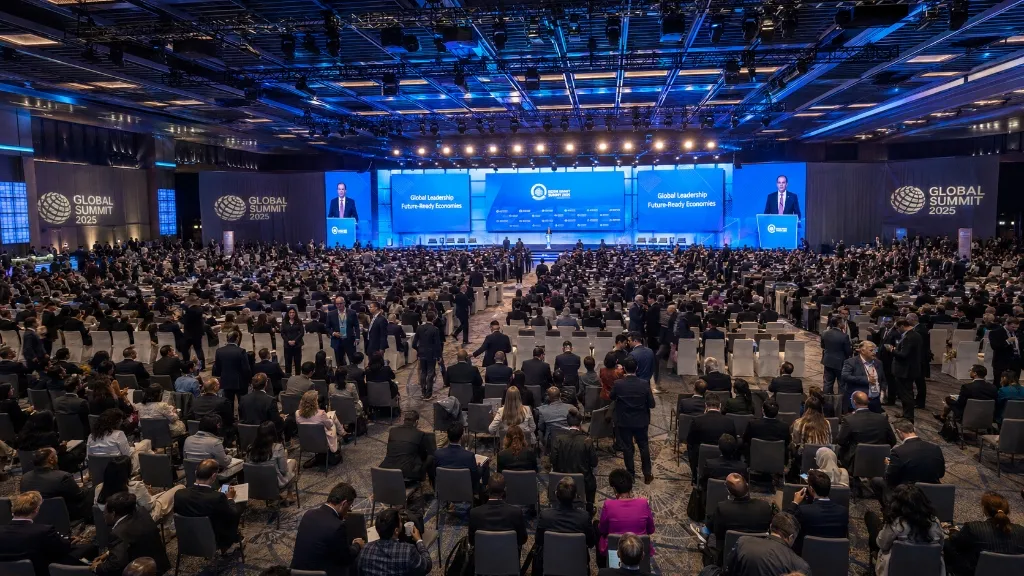
This operational framework reflects our proven execution on the ground. Explore our verified production case studies for deep-dive technical breakdowns:
- National Leadership Summit at Taj Palace, New Delhi: Turnkey staging, curved 4K LED, and acoustic line-arrays for 1,200 delegates.
- International MICE Conclave at JICC, New Delhi: Mega convention operations, 4 simultaneous session tracks, and global delegate hospitality for 2,500 attendees.
- Decade of Innovation Gala at ITC Maurya, New Delhi: Corporate anniversary visual journey, kinetic lighting, and executive gala staging for 800 guests.
- 25th Silver Jubilee Anniversary Gala at The Leela Gurugram: Bespoke corporate celebration staging, crystal lighting, and VVIP hospitality for 500 executives.
High-Stakes Corporate Event Production Checklist
Use this practical checklist to ensure all critical technical and operational parameters are verified before and during show day:
| Production Phase | System / Task | Verification Standard | Risk Mitigated |
|---|---|---|---|
| Pre-Production | 3D Spatial CAD Modeling | Stage height and sightline simulation approved for all seating tiers | Blocked attendee sightlines and neck strain |
| Pre-Production | Acoustic Venue Simulation | Soundvision / ArrayCalc SPL mapping verified within ±2 dB across hall | Acoustic dead zones and excessive reverberation |
| Pre-Production | Freight Dock Booking | Written venue security pass confirmation for specific overnight delivery slots | Dock congestion and delayed assembly windows |
| Setup (T-24h) | Truss Load Certification | Chartered structural engineer sign-off on all suspended rigging points | Catastrophic structural failure or ceiling damage |
| Setup (T-18h) | Clean Power Isolation | Audio/video distribution boards completely isolated from lighting/chillers | Ground hum, audio buzzing, and voltage spikes |
| Setup (T-12h) | RF Spectrum Scan | Active RF spectrum scan identifying interference-free frequencies | Wireless microphone dropouts during CXO speeches |
| Rehearsal (T-4h) | Slide Deck Aspect Check | All keynote slides formatted to native 16:9; embedded videos tested with audio | Distorted visuals, missing fonts, or silent video playback |
| Rehearsal (T-2h) | Full Cue Sheet Dry Run | Technical Director, Stage Manager, and FOH crew complete timed mock rehearsal | Misaligned speaker introductions and missed cues |
| Show Day (T-0) | UPS & DG Live Failover Test | Physical simulation of mains cutover with zero interruption to video or audio | Stage blackout during live executive presentation |
| Show Day (T-0) | Registration Kiosk Test | Thermal printers, optical scanners, and badge generation verified under 3 sec/pass | Morning delegate queue bottlenecks and delayed opening |
| Post-Show (T+1) | Safe Strike & Handover | Zero-damage venue inspection report signed with hotel / convention management | Venue security deposit disputes and equipment losses |
Frequently Asked Questions About Corporate Event Production in Delhi NCR
For summits hosting 1,000 to 2,500 delegates across premier Delhi NCR venues (such as Taj Palace, JICC, or Bharat Mandapam), a 10 to 12-week planning horizon is standard. This provides adequate lead time for 3D spatial CAD modeling, municipal licensing (Delhi Fire Service and traffic NOCs), procurement of customized stage fabrication, line-array acoustic modeling, and technical rehearsals.
We deploy dual-synchronized diesel generator (DG) sets configured in N+1 hot-standby redundancy with automated transfer switches. Crucially, we physically segregate AV 'clean power' lines from lighting and HVAC loads, and back all front-of-house consoles, video switchers, and LED sending processors with true online double-conversion UPS battery systems providing instantaneous zero-millisecond failover.
Applicable Central Pollution Control Board (CPCB) and Noise Pollution Rules requirements govern ambient noise at the relevant property boundary (such as 65 dB(A) daytime and 55 dB(A) nighttime limits in commercial zones), while indoor ballroom sound reinforcement must be designed with acoustic containment, directional dispersion, and venue-specific decibel controls. Outdoor amplified sound remains subject to strict local restrictions, including the 10:00 PM to 6:00 AM nighttime restriction under the Noise Pollution Rules where applicable.
Feedback suppression relies on combining directional lapel or miniature headset microphones, automated speech mixing algorithms on digital mixing consoles, dynamic parametric notch filters tuned during acoustic calibration, and time-aligned line-array speaker positioning that directs acoustic energy away from the stage apron into the audience seating planes.
An event decorator focuses exclusively on surface aesthetics, basic floral arrangements, and decorative backdrops. A technical event production agency like Aquila Events engineers structural safety, electrical load distribution, broadcast-grade video switching, RF wireless coordination, acoustic mapping, venue regulatory compliance, and minute-by-minute live show calling with certified technical directors.
Our video architecture runs on master presentation management systems (such as Barco E2 or Analog Way) fed by primary and secondary graphics workstations with seamless preview busses. When an updated deck arrives, it is loaded, formatted to native 16:9 aspect ratios, and reviewed on dedicated off-air preview monitors before being cut live between speaker introductions without audience-facing blackouts.
Planning a High-Stakes Corporate Summit in Delhi NCR?
Connect directly with our technical event architects for comprehensive venue feasibility, 3D spatial staging designs, and turnkey production execution.
Ready to Produce Your Next Event?
Consult directly with our technical event architects for turnkey production, staging, and logistics across India.