
Executive Answer: How to Plan a Destination Wedding on a 12-Month Timeline
A multi-day destination wedding is fundamentally a live experiential production. Unlike a single-evening metro banquet where guests arrive and depart within five hours, a destination celebration requires managing continuous 72-hour hospitality, multi-venue logistics, guest airport transfers, bespoke mandap architecture, and technical staging across 4 to 6 separate functions. To prevent logistical breakdowns and financial waste, couples must resolve five foundational decisions before signing secondary contracts: (1) Target Destination & Auspicious Dates, (2) Total Realistic Budget Framework, (3) Venue Availability & Buyout Terms, (4) Estimated Guest Count Bracket, and (5) Contracted Hotel Room Inventory.
Operational Note: A 12-month calendar is an optimal planning benchmark, not an inflexible requirement. Intimate celebrations (75 to 100 guests) or weddings booking non-peak dates can comfortably compress this framework into 4 to 8 months by engaging an integrated turnkey event production partner early.
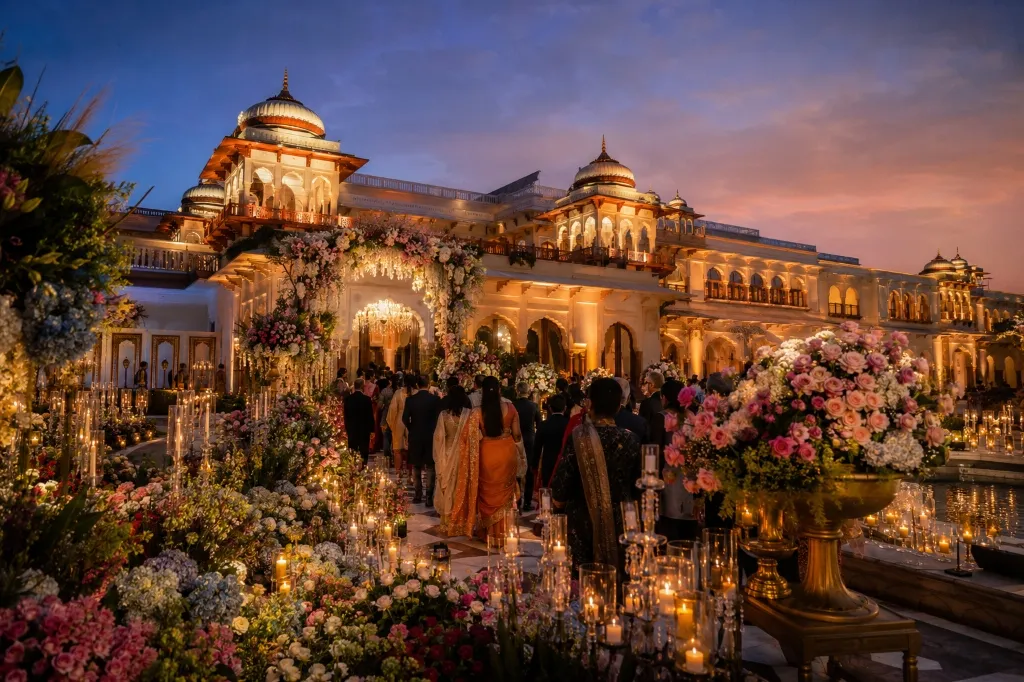
Planning a luxury destination wedding in India is an exhilarating journey of creative vision and familial celebration. Whether you dream of a regal multi-day celebration among the mirrored courtyards of a Rajasthan heritage palace or an oceanfront gathering on the pristine white sands of South Goa, the complexity of managing outstation guests and remote vendors requires rigorous chronological discipline. Decisions made at Month 12 directly determine what is structurally and financially possible at Month 2.
Too often, couples begin by browsing bridal couture or locking celebrity performers before securing the physical infrastructure that supports them. A world-class DJ is constrained if outdoor sound rules or venue curfews limit the celebration; a monumental floral mandap must be designed around property-specific drilling, anchoring, rigging and structural load limits; and booking 250 guests into a boutique resort with only 50 rooms creates an immediate logistical crisis. For a detailed commercial comparison of venue buyouts, catering tiers, and production expenses across major regions, review our comprehensive guide to destination wedding costs in Rajasthan vs Goa.
Below, the senior wedding production directors at Aquila Events provide a complete, copy-ready 12-month destination wedding planning checklist. This operational manual outlines chronological phases, milestone dependencies, a copy-ready master tracking worksheet, destination-specific safeguards for Rajasthan and Goa, a governance responsibility matrix, and a final-week readiness protocol.
The 12-Month Destination Wedding Chronological Timeline
Disciplined wedding production follows a staged progression where each phase establishes the operational foundation for the next. Below is the chronological blueprint tested across hundreds of luxury destination celebrations:
Phase 1: 12 to 10 Months Before — Foundation, Vision & Core Commitments
The first 60 days establish the strategic and financial boundaries of your celebration. Attempting to negotiate with secondary vendors before locking your venue and baseline parameters leads to conflicting commitments and budget drift.
- Establish Core Priorities & Budget Parameters: Align both families on the scale, religious traditions, and desired aesthetic (e.g., regal Rajputana grandeur vs. relaxed coastal chic). Establish a realistic total budget envelope across the 9 core pillars: venue, rooms, banqueting, decor, technical AV production, photography, entertainment, guest logistics, and an explicit 10% contingency buffer.
- Shortlist Destinations & Venue Archetypes: Evaluate primary regions based on guest transit and accessibility. Determine whether your celebration fits an exclusive heritage palace buyout in Rajasthan (Jaipur, Udaipur, Jodhpur) or a sprawling 5-star beachfront property in Goa (South Goa luxury belt).
- Check Calendar Dates & Seasonal Considerations: Cross-reference auspicious wedding dates (muhurats) against regional weather patterns. In Rajasthan, desert winter evenings between November and February drop to 8°C–12°C, requiring commercial heating solutions; in Goa, peak coastal dry weather runs from November through February, while shoulder months (October and March) offer significant pricing advantages but require rain and humidity contingency planning.
- Evaluate Room Inventory & Attrition Clauses: Calculate your guest-to-room ratio (typically 1.8 to 2.2 guests per room). Ensure the flagship property can accommodate at least 80% of your guest list under one roof. Review hotel contract terms carefully, noting mandatory room buyout minimums, food and beverage commitments, and attrition deadlines (the date by which unallocated rooms can be released without 100% financial penalty).
- Establish Governance & Decision-Making Authority: Clarify who holds final approval on creative concepts, vendor contracts, guest lists, and financial disbursements. Appointing a single family spokesperson streamlines communications and prevents vendor confusion.
- Initialize the Master Planning Tracker: Set up a centralized, cloud-hosted tracking repository covering budget line items, contract repositories, payment milestone schedules, and preliminary guest contact details.

Phase 2: 9 to 7 Months Before — Venue Contracts, Event Concept & Guest Communications
With the destination and venue confirmed, the operational focus shifts to locking primary partner agreements, defining the multi-day experiential flow, and giving outstation guests ample runway to plan their journey.
- Execute Venue Contracts & Secure Deposits: Finalize contractual terms with the host property. Ensure all event spaces (lawns, courtyards, ballrooms, pool decks) are reserved in writing with explicit load-in and strike access hours. Pay the initial booking deposit to guarantee date exclusivity.
- Define the Multi-Day Event Architecture: Map out the ceremony sequence across 3 or 4 days. A classic itinerary features: Day 1 Evening Welcome Dinner or Sunset Cocktail; Day 2 Poolside Mehendi/Haldi followed by a High-Production Sangeet; Day 3 Traditional Baraat, Mandap Pheras, and Formal Reception Gala. Establish the distinct energy, dress code, and culinary profile for each function.
- Appoint Turnkey Wedding Production & Planning Partners: Engage an integrated event production company like Aquila Events. Note that bespoke palace fabrication, custom mandap engineering, 3D CAD modeling, and specialized equipment staging generally require 2 to 6 months of technical pre-production notice. Final technical and structural production planning occurs systematically within the broader 12-month wedding timeline.
- Dispatch Save-the-Dates: Send digital or artisanal physical Save-the-Dates to outstation guests. Include the destination city, confirmed dates, nearest airport codes (e.g., Jaipur JAI, Udaipur UDR, Goa GOI/GOX), and hotel booking guidance so guests can secure commercial airfares before rates climb.
- Draft Initial Ground Transportation & Accommodation Architecture: Map out primary guest room blocks and identify satellite overflow properties within a 10-to-15-minute radius if guest numbers exceed flagship venue capacity. Outline preliminary shuttle routes and luggage transfer logistics.
- Catalog VIP Dignitaries & Accessibility Needs: Document elderly relatives, young children, and VIP guests requiring specialized room locations (ground floor, elevator proximity), wheelchair access ramps, customized diets, or personal attendants.
Phase 3: 6 to 4 Months Before — Creative Scenography, Menus & Major Vendor Locks
This phase translates abstract themes into tangible physical environments, detailed culinary experiences, and locked vendor commitments.
- Develop 3D Scenography & Structural Staging Plans: Review 3D CAD architectural renders for every event zone: sacred mandap pavilions, entrance gateways, Sangeet performance stages, dynamic dance floors, and thematic dining lounges. Ensure all designs respect venue structural limits and heritage preservation guidelines.
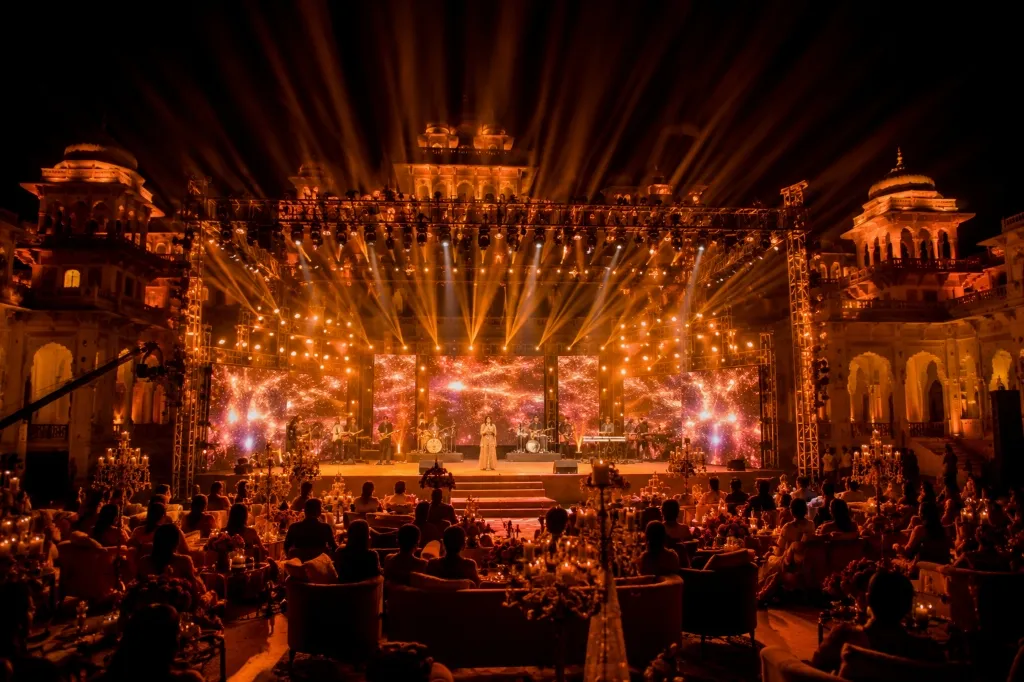
- Progress Technical Production & Acoustic Engineering: Specify line-array audio systems (e.g., L-Acoustics or JBL VTX), intelligent moving profile fixtures, architectural facade illumination, fine-pitch curved LED backdrop walls (P2.6/P2.9), and engineered electrical backup capacity with seamless changeover arrangements tailored to total production load.
- Conduct Menu Tastings & Culinary Curation: Attend comprehensive on-site tasting sessions with the venue's executive culinary team or empanelled outdoor caterers. Curate diverse regional spreads (Marwari thalis, coastal Goan curries, authentic Awadhi live counters) and international culinary stations. Finalize beverage mixology programs and verify bar licensing logistics.
- Contract Core Creative Vendors: Finalize agreements with your principal photography and 4K cinematography team, master hair and makeup artists (MUA), live Sangeet party bands, celebrity DJs, emcees, and traditional folk performers. Review vendor riders (travel, accommodation, technical consoles, sound checks) and integrate them into your production schedule.
- Refine Guest Lists & Review Attrition Windows: Review initial RSVP responses. Reconcile room allocations against your hotel contract before the first attrition cutoff (typically 90 to 120 days out) to adjust your room block without penalty.
- Confirm Applicable Permissions, Licenses & Safety Clearances: Identify the specific permissions, statutory licenses, and safety documentation required for your chosen venue, location, and planned activities. For coastal properties, determine whether Coastal Regulation Zone (CRZ) clearances or municipal beach event permissions apply to your specific beachfront parcel and event setup, or whether the venue’s existing operational licenses suffice. Confirm commercial music performance licensing requirements (such as PPL, IPRS, or Novex) and fire safety documentation with the venue and relevant authorities.
Phase 4: 3 to 2 Months Before — Logistical Precision, Run Sheets & Rehearsals
As the date nears, planning transitions from creative design into minute-by-minute operational choreography.
- Dispatch Formal Invitations & Launch RSVP Portal: Issue formal wedding invitation suites with detailed function cards, daily dress codes, arrival logistics, and access to a dedicated online guest concierge portal. Establish an unyielding RSVP deadline 5 to 6 weeks prior to the event.
- Build Flight Arrival Manifests & Fleet Schedules: Collect incoming flight numbers, arrival times, and passenger manifests from all travelling guests. Group arrivals into scheduled luxury coach and SUV shuttles, assigning dedicated luggage vans to handle excess baggage directly from airport cargo belts to hotel rooms.
- Draft Minute-by-Minute Run-of-Show Schedules: Create master event cue sheets detailing start times, music cues, baraat assembly, bridal entries, stage lighting presets, family choreography sequences, speech durations, and meal service commencement for every single function.
- Coordinate Artist & Performer Production: Finalize technical sound riders with performance artists. Schedule stage rehearsals, audio frequency coordination (to prevent microphone cross-talk), and backstage green-room hospitality rosters.
- Establish Weather Contingency Protocols: Review formal Rain & Wind Contingency Plans. Confirm waterproof tensile canopy availability, covered backup banquet spaces, drainage plans for outdoor lawns, and heating or cooling infrastructure.
- Define Change-Order & Escalation Protocols: Establish clear on-ground decision protocols: designate who has authority to approve on-site financial adjustments (e.g., adding extra rooms, extending bar hours, or requesting additional generator run-time) to prevent unauthorized cost escalation.
Phase 5: 4 to 2 Weeks Before — Final Reconciliations & Technical Master Schedule
The final month is dedicated to data freezing, contract verification, and operational dry runs.
- Freeze Final Attendance & Room Allocations: Reconcile all RSVPs. Issue a locked guest manifest to the hotel's front office, specifying room sharing, check-in dates, bed types, key-card pre-coding, and personalized welcome hamper distribution assignments.
- Lock Banquet Headcounts & Dietary Rosters: Submit certified meal guarantees to venue banquet directors and catering managers. Highlight medical allergies, Jain vegetarian requirements, vegan preferences, and children's meal requirements.
- Confirm Loading Dock Access & Dark-Hour Setup Windows: Coordinate load-in schedules with hotel security. Heavy fabrication, trussing delivery, and floral staging require 8 to 24 hours of advance ballroom or lawn access; secure written confirmation for early-morning or late-night setup windows.
- Finalize Technical Cue Sheets & Rehearsal Windows: Distribute finalized audio/visual cue sheets to the technical show director, lighting programmers, sound engineers, and family choreography coordinators. Schedule closed-door family rehearsals on the fabricated stage.
- Issue Master Contact Directory: Publish a comprehensive operational directory listing mobile numbers, radio channels, and specific roles for all department heads: hotel general manager, banquet lead, production director, transportation captain, bridal shadow, and family leads.
Phase 6: Final 48 Hours & Wedding Days — On-Ground Command
During the live wedding weekend, flawless execution relies on command-center discipline, active hospitality, and proactive problem resolution.
- Conduct Comprehensive Technical & Venue Walkthroughs: Production directors and the family spokesperson inspect all function zones 24 hours before guest arrivals: testing audio coverage across lawns, checking stage stability, inspecting floral freshness, and verifying sanitary facilities.
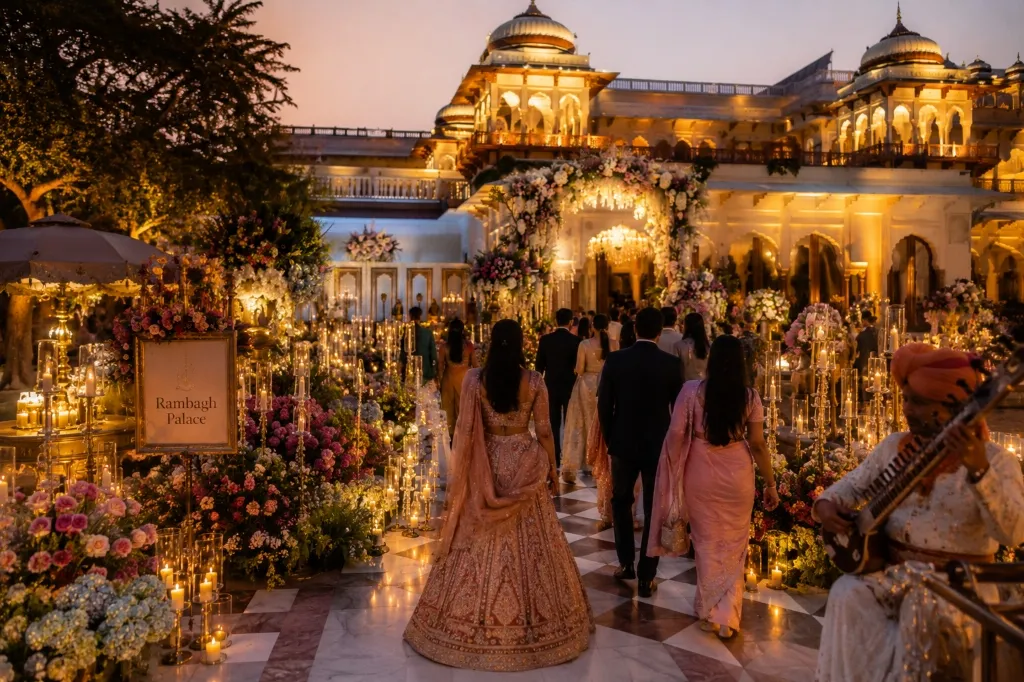
- Activate the 24-Hour Hospitality Concierge Desk: Position dedicated hospitality coordinators at airport arrival terminals, railway stations, and hotel lobbies to welcome guests with cold towels, refreshments, pre-coded key cards, and welcome hampers.
- Conduct Electrical Load & Backup Power Redundancy Testing: In coordination with the venue engineering team and technical production leads, calculate required electrical capacity and verify dedicated backup power units. Conduct live changeover and load-bank tests under simulated peak event loads (audio, lighting fixtures, LED displays, catering chillers) to confirm stable voltage regulation and uninterrupted ceremony power.
- Execute Live Event Direction (Minute-by-Minute Show Calling): The show caller manages backstage cues, coordinates the Baraat procession, cues bridal walk music, synchronizes cold-pyro or rose petal showers, and directs catering transitions seamlessly.
- Post-Event Strike, Damage Inspection & Final Reconciliation: Supervise safe stage dismantling and floral clearance. Conduct joint post-event property inspections with hotel management to ensure zero structural or heritage damage. Reconcile hotel incidentals, extra beverage consumption, and vendor final milestone payments within 7 to 14 days post-wedding.
Master Destination Wedding Planning Checklist Table
Below is a copy-ready master operational checklist. Families and planning committees can use this structured matrix to assign task ownership, track milestone dependencies, and verify required evidence at every phase:
| Planning Phase | Action Item & Operational Deliverable | Suggested Owner | Deadline / Dependency | Confirmation / Evidence Required | Status |
|---|---|---|---|---|---|
| 12–10 Months | Finalize total budget envelope & guest count bracket | Host Family | Prior to venue shortlisting | Approved 9-pillar budget spreadsheet | Pending |
| 12–10 Months | Conduct property recce in Rajasthan or Goa | Couple & Planner | T-10 Months | Venue recce report & capacity analysis | Pending |
| 12–10 Months | Execute flagship hotel contract & pay deposit | Host Family | T-10 Months | Countersigned contract & payment receipt | Pending |
| 9–7 Months | Appoint turnkey wedding production partner | Host Family | T-8 Months (2–6 mo pre-prod) | Signed agency agreement & scope BOQ | Pending |
| 9–7 Months | Dispatch digital Save-the-Date communications | Couple | T-8 Months | Guest delivery confirmation & website link | Pending |
| 9–7 Months | Lock event flow sequence & function timings | Planner & Couple | T-7 Months | Approved 3-to-4 day event schedule | Pending |
| 6–4 Months | Review 3D CAD mandap & stage designs | Production Team | T-5 Months | Approved 3D architectural renders | Pending |
| 6–4 Months | Conduct on-site food & beverage tasting | Couple & Caterer | T-5 Months | Final signed banquet menus & tasting notes | Pending |
| 6–4 Months | Contract photo, cinema, DJ, Emcee & live band | Planner & Family | T-4 Months | Executed vendor contracts & technical riders | Pending |
| 6–4 Months | Review room block attrition cutoff window | Logistics Lead | T-4 Months (per contract) | Written room release confirmation to hotel | Pending |
| 3–2 Months | Dispatch formal invitations & launch RSVP desk | Couple | T-10 Weeks | Invitation distribution tracking sheet | Pending |
| 3–2 Months | Build airport flight arrival & transfer manifest | Logistics Team | T-6 Weeks | Master flight tracking & vehicle grid | Pending |
| 3–2 Months | Draft minute-by-minute run-of-show cue sheets | Show Director | T-6 Weeks | Complete cue sheet for all functions | Pending |
| 3–2 Months | Confirm applicable municipal, coastal & music licenses | Production Team | T-4 Weeks | Permit documentation & venue safety records | Pending |
| 4–2 Weeks | Freeze final guest manifest & rooming allocations | Host Family | T-3 Weeks | Locked rooming list delivered to hotel GM | Pending |
| 4–2 Weeks | Lock certified banquet numbers & special diets | Planner | T-2 Weeks | Certified meal guarantee signed by chef | Pending |
| 4–2 Weeks | Confirm setup windows & loading dock clearances | Production Team | T-2 Weeks | Written hotel security gate pass approval | Pending |
| Wedding Week | Conduct full technical, acoustic & safety walk | Production Director | T-24 Hours | Signed structural & safety checklist | Pending |
| Wedding Week | Test backup power capacity & changeover systems | Technical & Venue Team | T-12 Hours | Load test signoff & power reserve check | Pending |
| Post-Wedding | Joint venue damage inspection & bill settlement | Planner & Venue | T+7 Days | Hotel final clearance & deposit refund | Pending |
Destination-Specific Planning Considerations: Rajasthan vs. Goa
Every destination possesses unique environmental, infrastructural, and legal constraints. Successful wedding production requires adapting your operational plan to local realities:
1. Rajasthan Heritage Palaces (Jaipur, Udaipur, Jodhpur)
Heritage palaces offer peerless regal romance, but their historic architectural status mandates strict operational conservation:
- Heritage Preservation & Property-Specific Installation Rules: Heritage venues enforce strict property-specific conservation guidelines. Drilling, ground anchoring, ceiling rigging, structural loads, and heavy equipment placements vary significantly between properties and must always be confirmed directly with venue conservation managers. Production teams typically specify certified self-standing ground-support systems with counterbalanced baseplates and protective surface underlay to safeguard historic sandstone, marble, and lawn surfaces. For waterfront venues, explore our guide to royal weddings and floating mandap engineering in Udaipur.
- Narrow Historical Access & Loading Windows: Palaces were engineered for royal defense, not modern 40-foot production trucks. Massive elephant gates, arched courtyards, and cobbled ramps often require trans-shipping materials from large highway trucks into small local commercial vehicles. Load-ins must be scheduled during dark hours (midnight to 6:00 AM) to avoid disrupting hotel daytime guests.
- Winter Courtyard Microclimates: In desert properties between November and February, daytime sunshine gives way to sharp evening temperature drops (8°C–12°C). Outdoor dinner courtyards require synchronized commercial patio heaters, decorative fire pits (angithis), warm lighting washes, and hospitality stations stocked with pashmina shawls.
- Multi-Property Room Cluster Coordination: Iconic palace buyouts (such as Rambagh Palace or Umaid Bhawan Palace) often provide 70 to 120 rooms. If your guest list exceeds 250 people, host satellite hotel room blocks across partner properties within a 10-minute radius, running dedicated luxury shuttle circuits around the clock.
2. Goa Luxury Beachfront Resorts (South & North Goa)
Goa combines coastal elegance with tropical vibrance, but maritime weather and coastal regulations dictate specialized engineering:
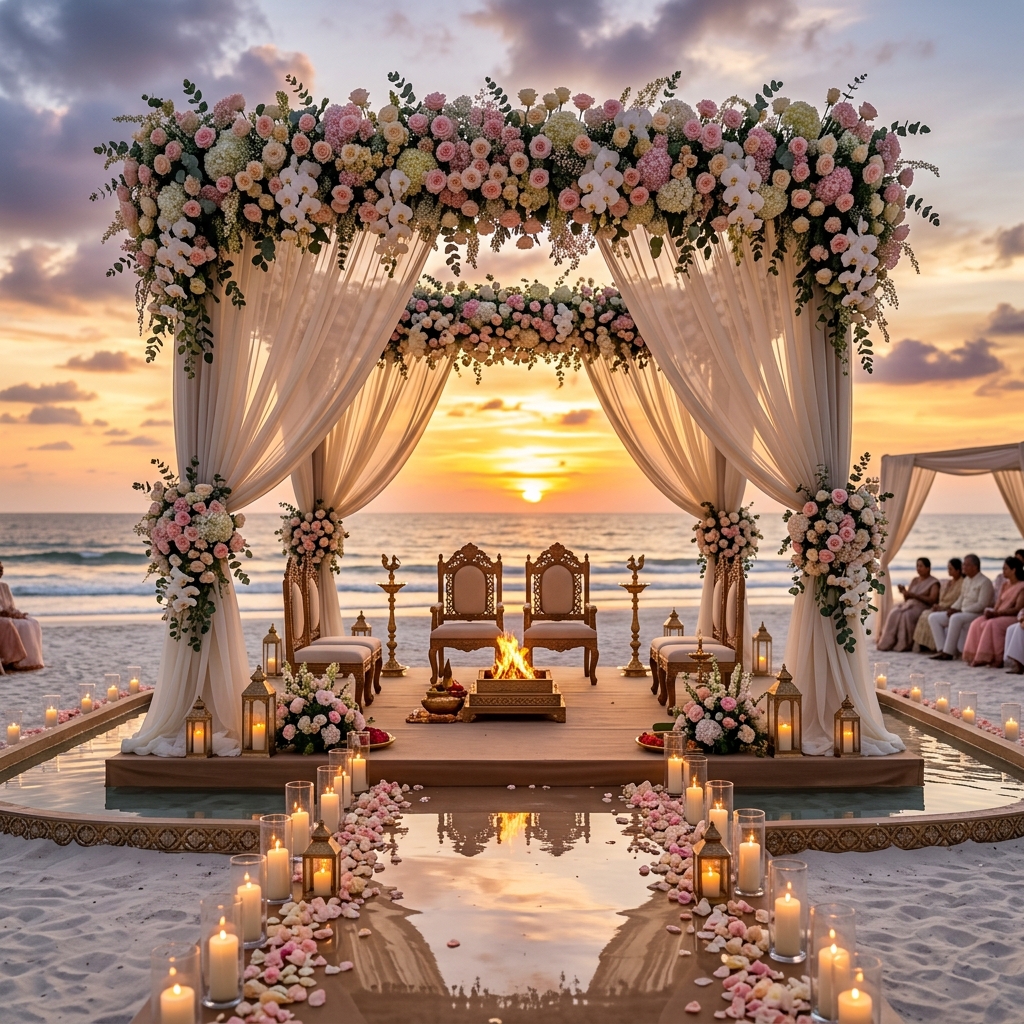
- Coastal Regulations & Beach Event Permissions: Environmental rules and Coastal Regulation Zone (CRZ) requirements depend strictly on the precise property boundaries, the nature of proposed temporary installations, and applicable local regulations. While permanent beachfront construction is strictly prohibited, whether a temporary open-sand mandap or lawn setup requires a standalone municipal clearance or falls under the resort's pre-approved commercial event permissions must be confirmed with the specific property and local authorities. In all cases, beach installations should incorporate eco-conscious waste management and protective sub-floor timber decking to ensure stability over soft sand without disturbing coastal terrain.
- Maritime Humidity, Salinity & Wind Ballast: Coastal ocean air carries corrosive salt spray and high humidity. Sensitive digital mixing consoles, frequency-managed wireless microphones, and LED processors require weatherproof coverings. Open-beach mandaps and truss arches require certified concrete ballast weights to resist unpredictable ocean wind gusts.
- Outdoor Sound Rules, Venue Curfews & Indoor Transitions: Applicable outdoor noise regulations, venue operating guidelines, municipal sound limits, and lawful extension exceptions vary across districts and individual properties. While many coastal resorts and outdoor heritage lawns establish an outdoor sound cutoff (commonly around 10:00 PM or as mandated by local authorities) to transition high-decibel music into sound-insulated indoor ballrooms or nightclubs, the exact curfew, permissible decibel thresholds, and any lawful special-occasion permissions must be verified directly with the property and local administration for your event dates. Production schedules should always incorporate smooth transition protocols between outdoor ceremonies and indoor after-parties. For resort-specific coastal layouts, see our insights on coastal luxury weddings in South Goa.
- Monsoon Shoulder-Month Contingencies: October and late March offer attractive resort rates, but coastal microclimates can generate sudden showers. Every outdoor lawn setup must have a designated, pre-blocked indoor ballroom backup space with identical seating capacity.
Planning Advisory: The parameters above reflect regional operational benchmarks. Exact venue rules, decibel limits, and loading restrictions must always be confirmed directly with your selected property and municipal authorities.
Critical Planning Dependencies: Why Early Decisions Shape Everything
In destination wedding production, decisions do not exist in isolation. A single change in one parameter triggers cascading consequences across your entire operational timeline:
- Guest Count Directly Drives Venue Selection & Fleet Logistics: Increasing your guest count from 150 to 250 does not merely add dinner plates; it pushes your accommodation beyond a single boutique property into multi-hotel satellite blocks, doubling transportation budgets, luggage dispatch vans, and hospitality desk staffing.
- Venue Physical Constraints Dictate Technical Production: Selecting a historic palace lawn with low load-bearing lawns or narrow archways restricts the weight and height of your stage and LED walls. Technical equipment must be specified to match venue access dimensions, power supply ratings, and floor weight limits.
- Function Count Dictates Crew Fatigue & Rehearsal Windows: Adding an impromptu late-night after-party or an extra afternoon high tea compresses the turnaround window between events. Decor crews require 6 to 8 hours to transform a lawn from a daytime Mehendi into a formal evening reception; overlapping functions eliminate setup time and necessitate hiring duplicate production shifts.
- RSVP Deadlines Determine Room Attrition Penalties: Hotel contracts enforce strict attrition cutoff schedules (e.g., releasing 10% of unbooked rooms 90 days out, and 5% 45 days out). If guest RSVPs are not locked before these dates, the host family remains contractually liable for the full cost of empty rooms.
- Weather Contingencies Require Dual Floor Plans: Planning an outdoor winter wedding in Rajasthan or a coastal beachfront wedding in Goa requires locking both an primary outdoor lawn and an secondary indoor ballroom. Decor and technical staging must be modular so they can pivot indoors within 3 hours if weather threatens.
Suggested Responsibility & Governance Matrix
A destination wedding involves dozens of independent entities. Clearly defining ownership between the host family, planner, venue, and specialized vendors prevents operational overlaps and communication gaps:
| Key Planning Domain | Couple & Host Family | Lead Wedding Planner | Flagship Host Venue | Production & Decor Partner | Catering & Bar Lead | Logistics Coordinator |
|---|---|---|---|---|---|---|
| Budget & Contract Approvals | Final Approval | Budget tracking & audit | Contract issuance | Line-item BOQ submission | Menu cost estimates | Fleet quotation audit |
| Guest Lists & RSVPs | List Owner | RSVP concierge portal | Room matrix confirmation | Seating layout integration | Dietary headcount tracking | Flight manifest compilation |
| Venue Sourcing & Spaces | Aesthetic selection | Contract negotiation | Space Management | Technical recce & layout | Kitchen infrastructure | Coach parking clearances |
| Creative Scenography & AV | Concept approval | Theme synchronization | Permit verification | Turnkey Execution | Buffet layout coordination | Equipment convoy transit |
| Banqueting & Bar Service | Tasting approval | Timing coordination | Culinary Preparation | Dining decor & lighting | Service Execution | Staff meal logistics |
| Transit & Hospitality | VIP list curation | Concierge supervision | Check-in desk space | Signage & registration desks | Welcome hampers / drinks | Fleet Dispatching |
| Sound, Licensing & Safety | Statutory fee funding | License audit | Sound rule compliance | Acoustic Compliance | Fire clearance compliance | Police & traffic liaison |
Disclaimer: The governance matrix above illustrates standard industry operational best practices. Actual legal and contractual liabilities are determined exclusively by individual signed vendor and venue agreements.
The Final-Week Readiness Checklist: 10 Operational Safeguards
During the final 7 days before guests arrive, eliminate ambiguity by executing this 10-point operational readiness review:
- 1. Master Run-of-Show Distribution: Distribute the finalized, version-controlled minute-by-minute schedule to all department heads, hotel management, family coordinators, and lead vendors.
- 2. Locked Flight Manifest & Vehicle Positioning: Verify flight schedules for incoming guests, confirm driver rosters, vehicle license plates, and dispatch luggage vans to airport holding bays.
- 3. Loading Dock Access & Gate Passes: Ensure hotel security has received approved vendor crew rosters, vehicle registrations, and gate pass clearances for dark-hour setup windows.
- 4. Certified Banquet Headcounts: Confirm exact plate counts, children's portions, vendor crew meals, and special dietary lists (Jain, vegan, gluten-free) with executive chefs.
- 5. Structural Staging & Safety Documentation: Perform structural load inspections on fabricated mandaps, elevated platforms, and overhead rigging, confirming relevant safety certificates, ballast weights, and venue compliance documentation with production engineers.
- 6. Sound Guidelines & Performance Licensing Verification: Confirm applicable sound cutoff hours, municipal noise permissions, and relevant commercial music performance licenses (such as PPL, IPRS, or Novex) with the venue and relevant authorities, ensuring physical copies or documentation are on site.
- 7. Backup Power Capacity & Changeover Testing: Confirm required generator capacity with your technical crew, review venue electrical changeover arrangements, and perform a qualified load test under peak operational draw to ensure seamless power continuity.
- 8. Weather Contingency Deployment Readiness: Confirm that waterproof canopies, covered ballroom alternate layouts, and patio heaters or chillers are on standby with clear deployment triggers.
- 9. Commercial Milestone Reconciliation: Reconcile all contracted vendor advance payments, verify on-site cash reserves for incidental tips or overtime, and establish clear signing authority for hotel master bills.
- 10. Post-Event Tear-Down & Damage Walkthrough Protocol: Pre-schedule the post-event joint property walkthrough with venue management to document pre-existing conditions and ensure rapid security deposit release.
Frequently Asked Questions About Destination Wedding Timelines
Ideally, destination wedding planning should commence 9 to 12 months in advance. Prime destination venues—such as heritage palaces in Rajasthan and 5-star beachfront resorts in South Goa—experience intense demand during peak season (October to March). Initiating planning a year ahead secures auspicious calendar dates, guarantees contiguous room blocks, locks in baseline tariffs before seasonal price surges, and provides outstation guests sufficient runway to arrange commercial flights and leave.
Yes. While 12 months is the ideal planning framework, high-production celebrations can be orchestrated within 4 to 8 months if couples remain flexible on calendar dates (or choose shoulder months such as October, February, or March) and partner with an experienced turnkey production agency. In accelerated timelines, venue selection, room block commitments, and core technical production must be locked concurrently within the first 30 days.
Your flagship venue and principal room block should be contractually confirmed 9 to 11 months before the wedding date. Until the venue contract is executed and the initial deposit is paid, downstream milestones—including wedding save-the-dates, bespoke 3D stage fabrication, catering menus, and sound licensing—cannot be finalized. Early booking also protects against room attrition penalties.
Save-the-Dates should be distributed 8 to 10 months in advance to give outstation and international guests ample opportunity to book commercial flights and secure travel visas. Formal wedding invitations—accompanied by an itemized itinerary, hotel check-in details, dress codes, and a digital RSVP portal—should be issued 8 to 10 weeks before the wedding, with an explicit RSVP deadline 5 to 6 weeks prior to arrival.
Creative concepts and 3D architectural renders should be initiated 6 months prior, with engineering structural drawings, electrical load calculations, and technical equipment specifications finalized 2 to 3 months before the event. Custom palace pavilions, floral mandaps, and specialized ground-support trussing require 2 to 6 months of pre-fabrication and structural certification before load-in.
The final week demands strict operational verification: (1) Reconciling airport arrival manifests against hotel room allocations, (2) Re-testing primary and twin-synchronized diesel backup generators under peak electrical loads, (3) Confirming municipal sound curfew permissions and copyright performance licenses (PPL/IPRS/Novex), (4) Locking banquet headcounts with venue chefs, (5) Walking the emergency weather contingency routes, and (6) Distributing the master contact sheet and minute-by-minute run-of-show to all department heads.
Plan Your Destination Wedding with Aquila Events
From engineering monumental self-standing mandaps in multi-century Rajasthan palaces to fabricating wind-resilient sunset stages on the private beaches of South Goa, Aquila Events delivers turnkey wedding production with absolute logistical precision and aesthetic excellence.
Begin Your 12-Month Wedding Planning Journey
Connect directly with our senior luxury wedding directors to review your tentative dates, guest count brackets, and preferred destinations. We provide transparent feasibility studies, 3D scenography concepts, and turnkey production direction tailored to your family's celebration.
Ready to Produce Your Next Event?
Consult directly with our technical event architects for turnkey production, staging, and logistics across India.